

3. SAXPY#
SAXPY stands for Single-precision A·X Plus Y — a classic numerical computing operation where a scalar multiplies a vector and the result is added to another vector:
y = a * x + y where a is a scalar, x and y are vectors
cuTile arithmetic operates on tiles. To multiply a tile by a scalar, broadcast the scalar to the tile’s shape.
Broadcasting#
Broadcasting takes a smaller value and replicates it to match a larger shape:
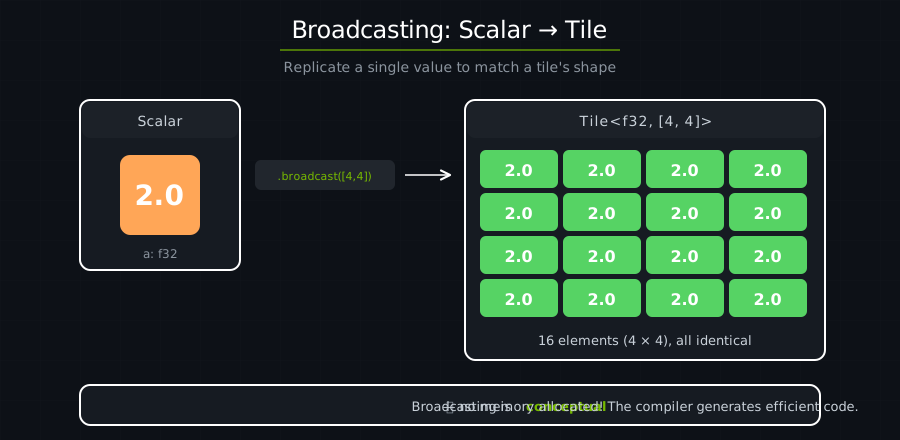
The compiler implements broadcasting without allocating memory for the copies.
use cuda_async::device_operation::DeviceOp;
use cuda_core::Device;
use std::sync::Arc;
use cutile;
use cutile::api::arange;
use cutile::error::Error;
use cutile::tensor::{IntoPartition, Reshape, Tensor, ToHostVec, Unpartition};

#[cutile::module]
mod my_module {
    use cutile::core::*;

    #[cutile::entry()]
    fn saxpy<const S: [i32; 2]>(
        y: &mut Tensor<f32, S>,            // Vector input AND output (in-place)
        a: f32,                           // Scalar input
        x: &Tensor<f32, { [-1, -1] }>     // Vector input
    ) {
        let tile_a = a.broadcast(y.shape());  // Scalar → Tile
        let tile_x = x.load_like(y);
        let tile_y = y.load();                // Load current y values
        y.store(tile_a * tile_x + tile_y);    // y = a*x + y
    }
}

use my_module::saxpy;

fn main() -> Result<(), Error> {
    let device = Device::new(0)?;
    let stream = device.new_stream()?;

    let a = 2.0f32;  // Our scalar multiplier

    // Create x and y as [0, 1, 2, ..., 31] reshaped to 4×8
    let input: Arc<Tensor<f32>> = arange(32usize).sync_on(&stream)?.into();
    let x: Arc<Tensor<f32>> = input.dup().sync_on(&stream)?.reshape(&[4, 8])?.into();
    let y = input.dup().sync_on(&stream)?.reshape(&[4, 8])?.partition([2, 2]);

    // Run: y = 2.0 * x + y = 2*x + x = 3*x
    let (y, a, _x) = saxpy(y, a, x).sync_on(&stream)?;
    let y_host: Vec<f32> = y.unpartition().to_host_vec().sync_on(&stream)?;

    // Verify
    for i in 0..5 {
        println!("{} * {} + {} = {} (got {})", a, i, i, 3 * i, y_host[i]);
    }

    Ok(())
}
Output:
2 * 0 + 0 = 0 (got 0)
2 * 1 + 1 = 3 (got 3)
2 * 2 + 2 = 6 (got 6)
2 * 3 + 3 = 9 (got 9)
2 * 4 + 4 = 12 (got 12)
In-Place Operations#
y is both an input and output:
let tile_y = y.load();             // Read current y
y.store(tile_a * tile_x + tile_y); // Write new y
This is an in-place operation — updating y rather than creating a new tensor. In-place updates reuse existing memory, avoiding the cost of a new allocation. SAXPY is traditionally in-place because it’s used in iterative algorithms where y is repeatedly updated.
Memory Flow#
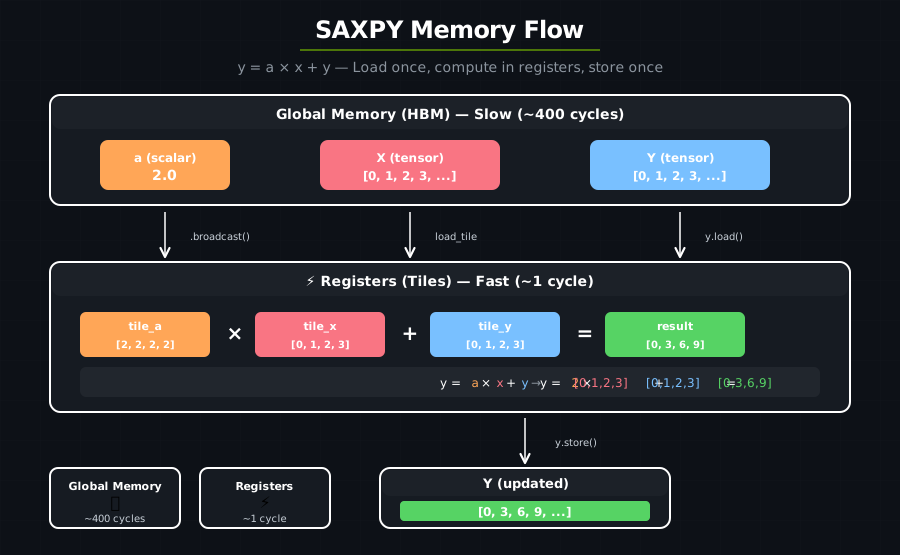
Global memory is slow (hundreds of cycles to access).
Registers are fast (single cycle).
Intermediate results stay in registers between the load and store.
Combining operations in one kernel (kernel fusion) avoids writing intermediate results to global memory.
y.shape()#
In the kernel:
let tile_a = a.broadcast(y.shape());
y.shape() returns the compile-time known shape of the output partition ([2, 2] in our case). This tells broadcast exactly what size tile to create.
Key Takeaways#
Concept |
What It Means |
|---|---|
Broadcasting |
Replicate a scalar/small value to match a larger shape |
In-place ops |
Update a tensor in place instead of creating a new one |
Memory hierarchy |
Global (slow) → Registers (fast) → Global |
y.shape() |
Returns the static shape used to partition the tensor |
Exercise 1: Change the Scalar#
Try a = 0.5 for scaling down instead of up. What results do you expect?
Exercise 2: Different Operation#
Modify to compute y = a * x - y instead. What’s the expected result for element 3?
Answer
y = 2.0 * 3 - 3 = 3
Exercise 3: Two Scalars#
Modify the kernel to compute y = a * x + b * y where both a and b are scalars.
Hint
fn saxpy_extended<const S: [i32; 2]>(
    y: &mut Tensor<f32, S>,
    a: f32, b: f32,
    x: &Tensor<f32, {[-1, -1]}>
) {
    let tile_a = a.broadcast(y.shape());
    let tile_b = b.broadcast(y.shape());
    let tile_x = x.load_like(y);
    let tile_y = y.load();
    y.store(tile_a * tile_x + tile_b * tile_y);
}
See also#
Tensors and Tiles — scalar arithmetic,
broadcast, and shape rulesDSL API —
broadcast,broadcast_scalar, and arithmetic operator signatures