

Warp-Level Programming#
A warp is CUDA’s fundamental scheduling unit: 32 threads that execute in lockstep on the same SM. Because all 32 threads share an instruction pointer, they can exchange data directly through warp shuffle instructions — register-to-register transfers that cost roughly one cycle and require no shared memory, no barriers, and no synchronization.
cuda-oxide exposes the full warp intrinsic set through cuda_device::warp.
This chapter covers shuffle, vote, and the patterns they unlock: warp
reductions, broadcasts, scans, and ballot-based filtering.
See also
CUDA Programming Guide — Warp Shuffle Functions for PTX encoding details and the full set of width variants.
Lane and warp identity#
Every thread in a block has a lane ID (0–31) within its warp:
use cuda_device::warp;

let lane = warp::lane_id();     // 0..31, hardware register %laneid
let warp = warp::warp_id();     // threadIdx.x / 32
warp_id() is derived from threadIdx.x / 32. For multi-dimensional
blocks, this only accounts for the x dimension — which is usually fine,
since most kernels that care about lane identity use 1D blocks.
Shuffle: register-to-register data exchange#
The four shuffle variants let a thread read another thread’s register without going through memory:
Function |
What it does |
Source lane |
|---|---|---|
|
Read from a specific lane |
|
|
Read from |
|
|
Read from |
|
|
Read from |
|
Each variant exists for both u32 and f32:
let partner_val = warp::shuffle_xor_f32(my_val, 1);
let broadcast   = warp::shuffle_f32(my_val, 0);     // lane 0's value to all
let neighbor    = warp::shuffle_down_f32(my_val, 1); // next lane's value
All shuffles are warp-synchronous — they implicitly synchronize the
warp. No sync_threads() is needed, and in fact calling sync_threads()
inside a shuffle pattern would be both unnecessary and wasteful.
Warp reduction#
The most common shuffle pattern is a butterfly reduction: in ⌈log₂(32)⌉ = 5 steps, every lane accumulates the sum (or min, max, etc.) of all 32 values. No shared memory, no barriers, five shuffle steps.
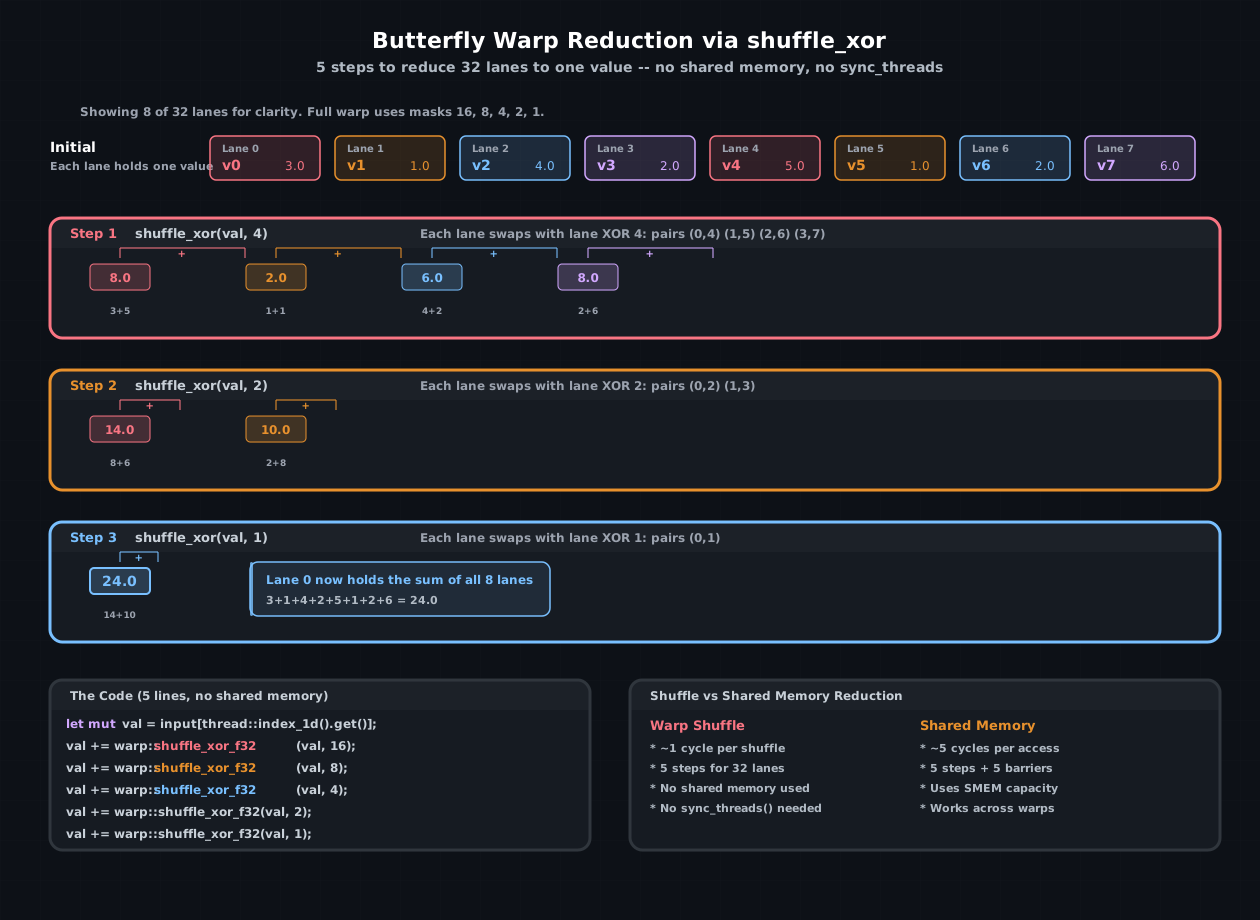
Butterfly reduction using shuffle_xor. At each step, lanes exchange
values with their XOR partner and add. After 5 steps (masks 16, 8, 4, 2,
1), lane 0 holds the sum of all 32 values.#
use cuda_device::warp;

fn warp_reduce_sum(mut val: f32) -> f32 {
    val += warp::shuffle_xor_f32(val, 16);
    val += warp::shuffle_xor_f32(val, 8);
    val += warp::shuffle_xor_f32(val, 4);
    val += warp::shuffle_xor_f32(val, 2);
    val += warp::shuffle_xor_f32(val, 1);
    val
}
After the reduction, all 32 lanes hold the sum (because XOR is
symmetric — both partners accumulate). If you only need the result in
lane 0, you can use shuffle_down instead:
fn warp_reduce_sum_lane0(mut val: f32) -> f32 {
    val += warp::shuffle_down_f32(val, 16);
    val += warp::shuffle_down_f32(val, 8);
    val += warp::shuffle_down_f32(val, 4);
    val += warp::shuffle_down_f32(val, 2);
    val += warp::shuffle_down_f32(val, 1);
    val
}
With shuffle_down, only lane 0 holds the correct result — the others
hold partial sums. This is fine when only lane 0 writes the output.
Tip
Need a block-wide reduction? Reduce within each warp using shuffles, write
the 32 per-warp results to shared memory, sync_threads(), then reduce
the warp-level results with one final warp. This hybrid approach is faster
than a pure shared memory tree because it eliminates 5 levels of barriers.
Integers on Ampere: one instruction instead of ten#
Every reduction above – the hand-written butterflies, and the generic
cooperative_groups::warp_reduce – costs five shuffles plus five combines.
For integer reductions on sm_80 and newer there is a single hardware
instruction, redux.sync, exposed one function per operation:
function |
reduces |
|---|---|
|
wrapping sum, |
|
minimum |
|
maximum |
|
bitwise |
use cuda_device::warp;

const FULL_MASK: u32 = 0xffff_ffff;

// The whole reduction. One instruction, every lane holds the result.
let total = warp::redux_sync_add(FULL_MASK, my_value);
Measured on an A10G (sm_86), 1M threads each performing 64 full-warp u32
sum reductions: the butterfly form takes 159.4 µs per launch, the redux.sync
form 33.6 µs – 4.74x, with bit-identical results. Wrapping u32 addition
is associative modulo 2³² and min/max/and/or/xor are exact, so reduction order
cannot change the answer.
That figure is the primitive measured in isolation: the probe kernel does almost nothing but reduce. A kernel that reduces once at the end of a memory-bound pass will see very little. Reach for this where reductions sit in an inner loop.
Three constraints:
Integers only on Ampere. There is an
f32form, but it needs Blackwell; see the next subsection.f64has noredux.syncform at all, sof64reductions keep the butterfly everywhere.A full, converged warp. All 32 lanes must be live and must reach the same call with the same mask – the same contract the shuffle reductions already require. Sub-warp tiles and short tail warps keep the shuffle path (see
reduce_sum_f32_partialand friends for the tail case).It will not assemble below
sm_80. Gate the call the way theredux_sumexample does, onctx.compute_capability(), or restrict the build to Ampere and newer.
warp_reduce does not select this form for you today; making it do so
automatically needs a way for device code to know its target architecture,
which is the open question in
#811.
Floats on Blackwell: redux.sync for f32#
redux.sync gained an f32 min/max form, exposed as eight functions. Each
takes (mask: u32, value: f32) and returns f32, like the integer ones:
function |
reduces |
|---|---|
|
minimum / maximum, NaN inputs ignored |
|
same, over the absolute values ( |
|
NaN-propagating ( |
|
both modifiers |
So unlike the integer family this is not one function per operation: .abs
and .NaN are independent instruction modifiers, and each combination is its
own entry point.
The .NaN forms matter for reductions that must not lose a NaN. The plain and
.abs forms ignore NaN inputs; the .NaN forms propagate NaN when any lane
contributes one. Pick deliberately. The two differ only when a lane holds a
NaN, and that is when the choice matters.
Say one lane holds NaN and the smallest ordinary value in the warp is -1.0:
redux_sync_min_f32(mask, v)returns-1.0(the NaN is ignored)redux_sync_min_nan_f32(mask, v)returnsNaN(the NaN propagates)
This is Blackwell-only, and narrower than “sm_100+”. The f32 forms need
PTX 8.6 and exist only on sm_100a, sm_100f, sm_103a, and sm_103f. They
are not available on sm_110a or sm_120a, so consumer Blackwell is out.
Build for one of those four targets or compilation fails.
The redux_f32 example is the working reference. It builds for sm_100a, so
CI compiles it and checks the emitted PTX rather than running it. Its main
skips unless the device reports sm_100 and nothing else.
Broadcast#
Broadcasting lane 0’s value to all lanes is a single shuffle:
let leader_val = warp::shuffle_f32(my_val, 0);
Any lane can be the source. This replaces the shared-memory pattern of “lane 0 writes to shared, sync, all lanes read” — one instruction instead of three operations.
Inclusive prefix sum (scan)#
An inclusive scan computes a running total: lane i holds the sum of
values from lanes 0 through i. The pattern uses shuffle_up:
fn warp_inclusive_scan(mut val: f32) -> f32 {
    let mut offset = 1u32;
    while offset < 32 {
        let n = warp::shuffle_up_f32(val, offset);
        if warp::lane_id() >= offset {
            val += n;
        }
        offset *= 2;
    }
    val
}
After 5 steps, each lane holds the prefix sum up to and including its own value. This is the building block for stream compaction, histogram building, and parallel scan algorithms.
Vote: warp-wide predicates#
Vote operations let the warp collectively evaluate a boolean condition:
Function |
Returns |
|---|---|
|
|
|
|
|
A |
|
Population count: how many active lanes have |
Filtering with ballot#
A common pattern is to compact an array, keeping only elements that pass
a predicate. ballot + popc gives you the count and the per-lane write
offset:
use cuda_device::{DisjointSlice, kernel, thread, warp};

#[kernel]
pub fn compact_positive(
    input: &[f32],
    mut output: DisjointSlice<f32>,
    mut count: DisjointSlice<u32>,
) {
    let idx = thread::index_1d();
    let val = input[idx.get()];
    let is_positive = val > 0.0;

    let mask = warp::ballot(is_positive);
    let lane = warp::lane_id();

    // Count bits below this lane to get the write position
    let offset = (mask & ((1u32 << lane) - 1)).count_ones();

    if is_positive {
        unsafe {
            *output.get_unchecked_mut(offset as usize) = val;
        }
    }

    // Lane 0 records total count for this warp
    if lane == 0 {
        unsafe {
            *count.get_unchecked_mut(warp::warp_id() as usize) = mask.count_ones();
        }
    }
}
The ballot mask encodes the entire warp’s predicate result in one
register. No communication, no shared memory — the hardware computes it in
a single cycle.
A complete example: warp-level dot product#
Putting shuffles and votes together, here is a kernel that computes the dot product of two vectors using warp reduction:
use cuda_device::{DisjointSlice, kernel, thread, warp};

#[kernel]
pub fn warp_dot_product(
    a: &[f32],
    b: &[f32],
    n: u32,
    mut result: DisjointSlice<f32>,
) {
    let idx = thread::index_1d();

    // Each thread computes one element of the pointwise product
    let product = if idx.get() < n as usize {
        a[idx.get()] * b[idx.get()]
    } else {
        0.0f32
    };

    // Warp-level reduction
    let mut sum = product;
    sum += warp::shuffle_xor_f32(sum, 16);
    sum += warp::shuffle_xor_f32(sum, 8);
    sum += warp::shuffle_xor_f32(sum, 4);
    sum += warp::shuffle_xor_f32(sum, 2);
    sum += warp::shuffle_xor_f32(sum, 1);

    // Lane 0 of each warp writes its partial sum
    if warp::lane_id() == 0 {
        unsafe {
            *result.get_unchecked_mut(warp::warp_id() as usize) = sum;
        }
    }
}
For a full dot product, launch a second pass that reduces the per-warp results — either with another warp kernel or with atomics. The first pass eliminates the vast majority of the work using only register shuffles.
See also
Shared Memory and Synchronization — the block-wide counterpart for larger-than-warp operations
Tensor Memory Accelerator — hardware that accelerates the global→shared data movement that feeds these patterns