gen_tr38901_multicell_topology#
- sionna.sys.gen_tr38901_multicell_topology(scenario: str, batch_size: int, num_ut_per_sector: int, carrier_frequency: float, num_rings: int = 2, use_3gpp_calibration_defaults: bool = True, isd: float | None = None, bs_height: float | None = None, min_bs_ut_dist: float | None = None, indoor_probability: float | None = None, apply_tr36873_indoor_heights: bool | None = None, return_site_positions: bool = False, enforce_indoor_distance: bool = True, precision: Literal['single', 'double'] | None = None, device: str | None = None) tuple[source]#
Generates a TR 38.901 multi-cell topology using Tables 7.8-1 and 7.8-2 for UMi/UMa and Table 7.2-3 for RMa of [TR38901V1920].
This helper creates the hexagonal multi-cell topology used for the UMi, UMa, and RMa calibration-style scenarios. By default, it generates a two-ring layout with 19 sites, three co-located sectors per site, wraparound virtual BS locations, and explicit site identifiers for sharing site-level random quantities across co-located sectors.
The sector boresights follow the Table 7.8 convention \(30^\circ\), \(150^\circ\), and \(270^\circ\).
UT locations are generated by a stratified sector drop. For every batch item, site, and sector, exactly
num_ut_per_sectorUTs are drawn. Each drop region is the actual intersection of a 120-degree sector with its site’s Voronoi hexagon. The intersection is triangulated from the site; triangles are selected in proportion to their area and sampled uniformly with barycentric coordinates. Samples that violatemin_bs_ut_distare rejected and redrawn. Indoor/outdoor state is drawn before the position. For indoor UTs, the rejection distance includes the home-site outdoor-to-indoor distance used by the calibration setup. Thus, the drop enforces equal UT counts per sector and is uniform over each admissible sector/Voronoi intersection.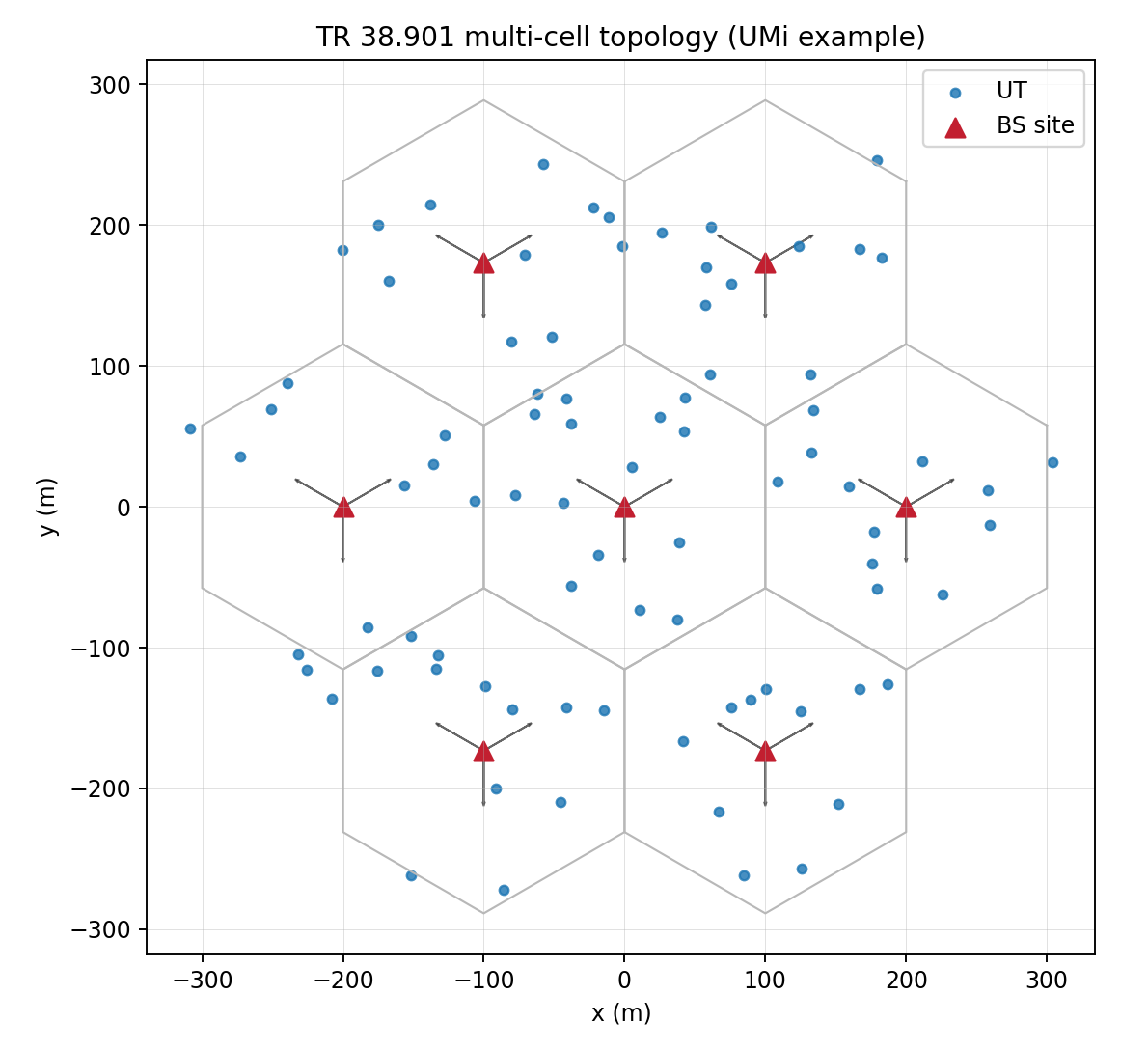
Fig. 29 Example one-ring UMi calibration topology with co-located BS sectors and stratified UT drops.#
- Parameters:
scenario (str) – Scenario. One of
"umi","uma", or"rma".batch_size (int) – Batch size.
num_ut_per_sector (int) – Number of UTs to drop per sector and batch.
carrier_frequency (float) – Carrier frequency [Hz]. For UMi and UMa below 6 GHz, the indoor distance follows the backward-compatible link-specific single-uniform model from Table 7.4.3-3. At 6 GHz and above, and for RMa, it is the minimum of two independent uniform variables according to Clause 7.4.3.1. Use the same value as for the channel model.
num_rings (int) – Number of rings in the hexagonal site layout.
use_3gpp_calibration_defaults (bool) – If True, missing topology parameters are filled with TR 38.901 Table 7.8 calibration defaults.
isd (float | None) – Inter-site distance [m].
bs_height (float | None) – BS height [m].
min_bs_ut_dist (float | None) – Minimum 2D BS-UT distance [m]. If None, the standard defaults are 10 m for UMi and 35 m for UMa and RMa.
indoor_probability (float | None) – Probability that a UT is indoor. For RMa, the remaining UTs are interpreted as in-car by the channel unless an explicit
in_carmask is supplied toset_topology().apply_tr36873_indoor_heights (bool | None) – If True, indoor UMi/UMa UT heights are drawn from the TR 36.873 floor-height model used by the calibration drops. If None, this is enabled for UMi/UMa and disabled for RMa. RMa UT heights are always 1.5 m according to Table 7.2-3.
return_site_positions (bool) – If True, return
(topology, site_positions)instead of onlytopology. Thetopologytuple can still be passed directly toset_topology().enforce_indoor_distance (bool) – If True, include the sampled indoor distance in the placement rejection threshold. This ensures that the outdoor part of every serving link respects
min_bs_ut_dist.precision (Literal['single', 'double'] | None) – Precision used for internal calculations and outputs. If set to None,
precisionis used.device (str | None) – Device for computation. If None,
deviceis used.
- Outputs:
ut_loc – [batch_size, num_ut, 3], torch.float. UT locations [m].
bs_loc – [batch_size, num_sites*3, 3], torch.float. BS sector locations [m].
ut_orientations – [batch_size, num_ut, 3], torch.float. UT orientations [radian]. The calibration topology leaves these at zero; Phase-2 calibration applies its UT-orientation distribution separately.
bs_orientations – [batch_size, num_sites*3, 3], torch.float. BS sector orientations [radian].
ut_velocities – [batch_size, num_ut, 3], torch.float. UT velocity vectors [m/s]. The calibration topology leaves these at zero.
in_state – [batch_size, num_ut], torch.bool. Indoor/non-indoor state of UTs. True means indoor. For RMa, the initial
set_topology()call interprets every False entry as in-car per Table 7.2-3 unlessin_caris supplied explicitly.los – None. Placeholder for stochastic LoS/NLoS sampling by the channel model.
bs_virtual_loc – [batch_size, num_sites*3, num_ut, 3], torch.float. Wraparound virtual BS sector locations [m].
bs_site_ids – [num_sites*3], torch.int64. Site identifier of each BS sector. Co-located sectors share the same identifier.
spatial_consistency_track_ids – None. Placeholder for optional spatial-consistency track identifiers.
distance_2d_in – [batch_size, num_ut] or [batch_size, num_sites*3, num_ut], torch.float. Indoor 2D distances [m]. UMi and UMa below 6 GHz return link-specific distances, with one value shared by the three sectors of each site. Other cases return UT-specific distances. Outdoor UTs have zero distance. The home-site value is used for placement rejection.
site_positions – [num_sites, 2], torch.float. Site center positions [m]. Returned separately from
topologyonly ifreturn_site_positionsis True.
Examples
from sionna.sys import gen_tr38901_multicell_topology

carrier_frequency = 3.5e9
topology = gen_tr38901_multicell_topology(
    "umi", 1, 2, carrier_frequency)
channel_model.set_topology(*topology)