Writing Optimization Problems
This tutorial will guide you through optimizing the Rosenbrock function using a custom rollout class and plugging it into cuRobo’s optimization pipeline.
cuRobo’s optimization pipeline is designed to be modular and extensible. The optimization pipeline consists of a rollout class and an optimization solver. The rollout class contains information about the optimization problem, including evaluation of costs and constraints given the optimization variables. The optimization solver is responsible for finding the optimal values by using the rollout class for evaluations.
Required Reading
Rosenbrock Function
The Rosenbrock function, also known as the banana function or Valley function, is a common test problem for optimization algorithms. It is defined as:
The function has a global minimum at (1,1) where f(1,1) = 0. The function’s name comes from its characteristic shape - a parabolic valley. While finding the valley is trivial, converging to the global minimum is difficult. The valley is very narrow and curved, making it a challenging optimization problem that tests an algorithm’s ability to navigate a narrow curved valley.
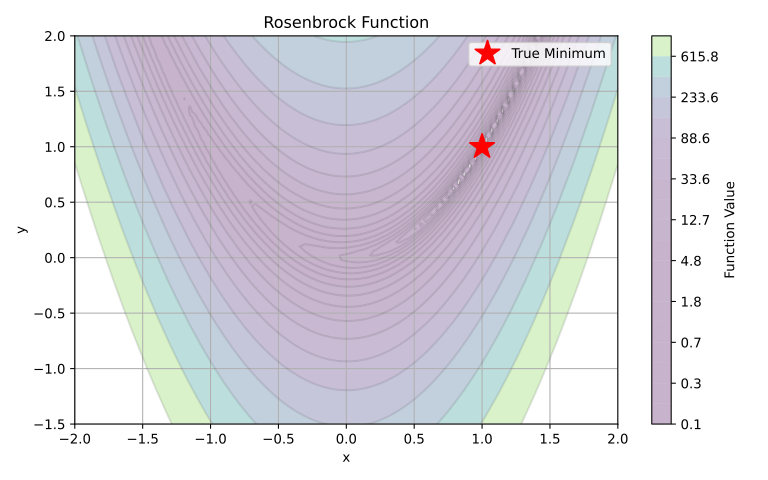
We want to go to the minimum from a random initial point.
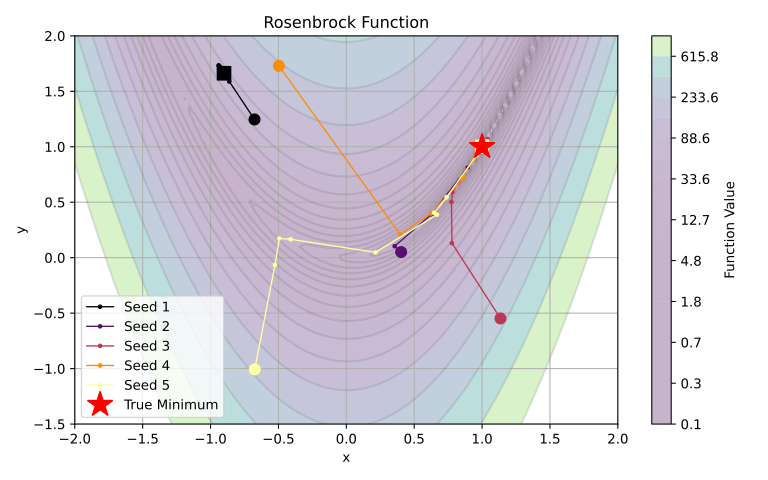
Optimization solvers can get stuck in local minima. To overcome this, some solvers randomly perturb when stuck. In cuRobo, we instead parallelize the optimization across multiple starting points (seeds) and leverage GPU compute to find the best solution.
We will next implement a custom rollout class that can then be plugged into cuRobo’s optimization pipeline. If you are unfamiliar with cuRobo’s Rollout class, see Rollout Classes before continuing.
Implementing a Custom Rollout Class
In this section, we’ll implement a custom rollout class for the Rosenbrock function. cuRobo
rollouts are defined structurally through the
Rollout Protocol – a rollout
is any class that exposes the right set of properties and methods. There is no base class to
inherit from. See Rollout Classes for the full Protocol.
The implementation has three parts:
Configuration – a plain
@dataclassholding parameters and dimensions. NoBaseRolloutCfgparent; just a regular dataclass.Implementing the rollout class – a standalone class whose public surface matches the
RolloutProtocol.Computing costs and constraints – implementing the Rosenbrock function inside the rollout’s forward pass.
The full reference implementation lives at
RosenbrockRollout; the snippets below mirror
it with short comments.
Let’s start with the configuration dataclass:
from dataclasses import dataclass
from typing import Dict, List, Optional

import torch

from curobo._src.rollout.metrics import (
    CostCollection,
    CostsAndConstraints,
    RolloutMetrics,
    RolloutResult,
)
from curobo._src.rollout.rollout_protocol import Rollout
from curobo._src.state.state_joint import JointState
from curobo._src.types.device_cfg import DeviceCfg


@dataclass
class RosenbrockCfg:
    """Configuration for the Rosenbrock rollout."""

    device_cfg: DeviceCfg
    a: float = 1.0
    b: float = 100.0
    dimensions: int = 2
    time_horizon: int = 1
    time_action_horizon: int = 1
    sum_horizon: bool = False
    sampler_seed: int = 1312
The dataclass holds the Rosenbrock parameters a and b, the problem dimensionality, and
the usual cuRobo rollout fields (device_cfg, horizon length, sum_horizon,
sampler_seed). Next, the rollout class itself. use_cuda_graph is a constructor
parameter – there is no mixin or subclass needed for CUDA-graph acceleration:
class RosenbrockRollout:
    """Rollout that evaluates the Rosenbrock cost for optimizer testing.

    f(x, y) = (a - x)^2 + b(y - x^2)^2

    For higher dimensions, uses the generalized form:
    f(x) = sum_{i=1}^{n-1} [ (a - x_i)^2 + b(x_{i+1} - x_i^2)^2 ]
    """

    def __init__(self, config: RosenbrockCfg, use_cuda_graph: bool = False):
        self.a = config.a
        self.b = config.b
        self.dimensions = config.dimensions
        self.time_horizon = config.time_horizon
        self.time_action_horizon = config.time_action_horizon
        self.device_cfg = config.device_cfg
        self.sum_horizon = config.sum_horizon
        self.sampler_seed = config.sampler_seed

        self._use_cuda_graph = use_cuda_graph
        self._action_bound_lows = (
            torch.ones((self.action_horizon,), **self.device_cfg.as_torch_dict()) * -1.5
        )
        self._action_bound_highs = (
            torch.ones((self.action_horizon,), **self.device_cfg.as_torch_dict()) * 2.0
        )
        self._batch_size = 1
Next, the properties the Rollout Protocol
requires (action_dim, action_horizon, action_bound_lows / action_bound_highs,
dt, sum_horizon):
@property
def action_dim(self) -> int:
    return self.dimensions

@property
def action_horizon(self) -> int:
    return self.time_action_horizon

@property
def action_bound_lows(self) -> torch.Tensor:
    return self._action_bound_lows

@property
def action_bound_highs(self) -> torch.Tensor:
    return self._action_bound_highs

@property
def dt(self) -> float:
    return 1.0
The Rosenbrock rollout is time-independent, so dt is just 1.0. sum_horizon is set
from the config in __init__ above.
The forward pass evaluates the Rosenbrock cost. evaluate_action is the hot loop used by the
optimizer on every iteration. The helper _compute_state_from_action_impl maps actions to
a JointState (for Rosenbrock the state is just the action), and
_compute_costs_and_constraints_impl evaluates the generalised Rosenbrock sum:
def evaluate_action(self, act_seq: torch.Tensor, **kwargs) -> RolloutResult:
    batch_size = act_seq.shape[0]
    if batch_size != self._batch_size:
        self.update_batch_size(batch_size)
    state = self._compute_state_from_action_impl(act_seq)
    costs = self._compute_costs_and_constraints_impl(state, **kwargs)
    return RolloutResult(actions=act_seq, state=state, costs_and_constraints=costs)

def _compute_state_from_action_impl(self, act_seq: torch.Tensor) -> JointState:
    # For Rosenbrock, the state is just the action.
    return JointState.from_position(act_seq)

def _compute_costs_and_constraints_impl(
    self, state: JointState, **kwargs
) -> CostsAndConstraints:
    x = state.position  # shape: [batch, horizon, dimensions]
    costs_and_constraints = CostsAndConstraints()

    # 2D Rosenbrock term.
    term1 = (self.a - x[:, :, 0]) ** 2
    term2 = self.b * (x[:, :, 1] - x[:, :, 0] ** 2) ** 2
    rosenbrock_cost = term1 + term2

    # Higher-dimensional terms.
    for i in range(1, self.action_dim - 1):
        term1 = (self.a - x[:, :, i]) ** 2
        term2 = self.b * (x[:, :, i + 1] - x[:, :, i] ** 2) ** 2
        rosenbrock_cost += term1 + term2

    # CostCollection uses add(value, name); it is not a list of tensors.
    costs_and_constraints.costs.add(rosenbrock_cost.unsqueeze(-1), "rosenbrock")
    return costs_and_constraints
The Protocol also requires post-optimization metrics hooks and a handful of lifecycle methods. For the Rosenbrock rollout these are short:
def compute_metrics_from_state(self, state: JointState, **kwargs) -> RolloutMetrics:
    costs = self._compute_costs_and_constraints_impl(state)
    convergence = costs.get_sum_cost(sum_horizon=False)
    return RolloutMetrics(
        costs_and_constraints=costs,
        feasible=costs.get_feasible(),
        state=state,
        convergence=convergence,
    )

def compute_metrics_from_action(
    self, act_seq: torch.Tensor, **kwargs
) -> RolloutMetrics:
    self.update_batch_size(act_seq.shape[0])
    state = self._compute_state_from_action_impl(act_seq)
    metrics = self.compute_metrics_from_state(state, **kwargs)
    metrics.actions = act_seq
    return metrics

def update_params(self, a: float = None, b: float = None, **kwargs) -> bool:
    if a is not None:
        self.a = a
    if b is not None:
        self.b = b
    return True

def update_batch_size(self, batch_size: int) -> None:
    self._batch_size = batch_size

def update_dt(self, dt, **kwargs) -> bool:
    return True  # dt is constant for Rosenbrock.

def reset(self, reset_problem_ids=None, **kwargs) -> bool:
    return True

def reset_shape(self) -> bool:
    return True

def reset_seed(self) -> None:
    pass  # Stateless sampler; nothing to reset.
That’s the entire class. RosenbrockRollout is a standalone class – no base class, no
mixins, no super() – and it satisfies the
Rollout Protocol, so it can be handed to any
cuRobo optimizer. Setting use_cuda_graph=True at construction time is the only switch
needed to record and replay the metrics hooks through a
GraphExecutor.
Using the Rosenbrock Rollout in an Optimization Pipeline
Now that we have a rollout, we can hand it to any of cuRobo’s optimization solvers. Read Optimization Solvers for an overview of the available solvers.
The end-to-end runnable script lives at curobo/examples/guides/custom_optimization.py; this section walks through its key pieces.
Rollout list idiom. Every optimizer accepts a rollout_list: List[Rollout] whose length
matches the optimizer’s num_rollout_instances field, so that a single optimizer can drive
multiple rollouts (e.g. one per line-search branch). Most solvers take a single rollout; L-BFGS
takes two. A small helper keeps the call sites short:
import torch

from curobo._src.optim.external.scipy_opt import ScipyOpt, ScipyOptCfg
from curobo._src.optim.gradient.lbfgs import LBFGSOpt, LBFGSOptCfg
from curobo._src.optim.multi_stage_optimizer import MultiStageOptimizer
from curobo._src.optim.particle.mppi import MPPI, MPPICfg
from curobo._src.types.device_cfg import DeviceCfg

device_cfg = DeviceCfg(device=torch.device("cuda:0"), dtype=torch.float32)

rosenbrock_config = RosenbrockCfg(
    a=1.0,
    b=100.0,
    dimensions=2,
    time_horizon=1,
    time_action_horizon=1,
    device_cfg=device_cfg,
)

def build_rollout_list(num_instances: int):
    return [
        RosenbrockRollout(rosenbrock_config, use_cuda_graph=True)
        for _ in range(num_instances)
    ]
MPPI. The particle-based MPPI solver samples actions from a Gaussian and updates the distribution from the cost-weighted statistics:
mppi_config_dict = {
    "num_iters": 10,
    "inner_iters": 5,
    "gamma": 1.0,
    "seed": 0,
    "store_rollouts": False,
    "num_particles": 1000,
    "solver_type": "mppi",
    "store_debug": True,
    "sample_mode": "BEST",
    "init_cov": 0.01,
    "kappa": 0.0001,
    "beta": 0.1,
    "step_size_mean": 0.9,
    "step_size_cov": 0.1,
    "null_act_frac": 0.0,
    "squash_fn": "CLAMP",
    "cov_type": "DIAG_A",
}
mppi_config = MPPICfg(**MPPICfg.create_data_dict(mppi_config_dict, device_cfg))
mppi_rollouts = build_rollout_list(mppi_config.num_rollout_instances)
mppi = MPPI(mppi_config, mppi_rollouts)
MPPICfg.create_data_dict drops any keys that are not valid
MPPICfg fields, so the dataclass constructor only
sees valid fields.
L-BFGS. The gradient-based L-BFGS solver takes a parallel line search step per iteration;
its default config has num_rollout_instances = 2:
opt_config_dict = {
    "num_iters": 50,
    "line_search_scale": [0.0, 0.01, 0.2, 0.3, 0.5, 0.75, 0.8, 0.9, 1.0, 2.0],
    "cost_convergence": 0.0,
    "cost_delta_threshold": 0.0,
    "fixed_iters": True,
    "store_debug": True,
    "history": 2,
    "epsilon": 0.001,
    "sync_cuda_time": True,
    "debug_info": None,
    "num_problems": 1,
    "use_coo_sparse": True,
    "solver_type": "lbfgs",
    "inner_iters": 1,
    "line_search_type": "wolfe",
    "line_search_wolfe_c_1": 0.001,
    "line_search_wolfe_c_2": 0.98,
    "step_scale": 1.0,
    "cost_relative_threshold": 0.999,
}
opt_config = LBFGSOptCfg(**LBFGSOptCfg.create_data_dict(opt_config_dict, device_cfg))
lbfgs_rollouts = build_rollout_list(opt_config.num_rollout_instances)
lbfgs_opt = LBFGSOpt(opt_config, lbfgs_rollouts, use_cuda_graph=True)
use_cuda_graph=True on the optimizer is an independent switch from the one on the rollout:
the rollout wraps its metrics hooks, and the optimizer wraps the inner evaluate_action
loop.
Chaining with MultiStageOptimizer. To chain MPPI’s global exploration with L-BFGS’s local
refinement, wrap them in a
MultiStageOptimizer. The multi-stage
wrapper itself satisfies the
Optimizer Protocol, so everything that
consumes an optimizer keeps working:
optimizer = MultiStageOptimizer(optimizers=[mppi, lbfgs_opt])
Running the optimizer. Pick a primary rollout for post-optimization analysis, set the batch size, get an initial action from the rollout’s Halton sampler, and run:
rosenbrock_rollout = lbfgs_rollouts[0]
batch_size = 1
rosenbrock_rollout.batch_size = batch_size
optimizer.update_num_problems(batch_size)

init_action = rosenbrock_rollout.get_initial_action()

for _ in range(2):  # Second run benefits from warmed-up CUDA graphs.
    optimizer.reinitialize(init_action)
    result = optimizer.optimize(init_action)

optimized_action = result
metrics = rosenbrock_rollout.compute_metrics_from_action(optimized_action)
print("Optimized action:", optimized_action.cpu().numpy())
print("Convergence cost:", metrics.convergence.cpu().numpy())
print("True minimum: [1.0, 1.0]")
Note that reinitialize
is the post-refactor replacement for the old reset() method – it resets solver state using
the seed action.
Recording and plotting the trace. When store_debug=True is set in the optimizer config,
optimizer.get_recorded_trace()["debug"] returns a list of per-iteration action tensors,
which you can plot over the Rosenbrock contour. See
visualize_batch_rosenbrock in
custom_optimization.py
for a complete matplotlib-based visualization.
Accelerating with CUDA Graphs
CUDA graphs reduce GPU kernel-launch overhead by recording a sequence of kernels once and replaying them on every subsequent call. In cuRobo, CUDA graphs are a constructor parameter – there is no mixin or subclass to inherit from:
# Rollout: wraps compute_metrics_from_state / compute_metrics_from_action.
rollout = RosenbrockRollout(rosenbrock_config, use_cuda_graph=True)

# Optimizer: wraps the inner evaluate_action loop of the solver.
lbfgs_opt = LBFGSOpt(opt_config, [rollout, rollout], use_cuda_graph=True)
The two switches are independent – the rollout captures one graph for each of its
post-optimization metrics hooks, and the optimizer captures its own graph for the hot loop.
Graphs are recorded lazily on the first call and replayed from then on, via
GraphExecutor. When either switch is left at
False, GraphExecutor transparently falls back to a direct function call, so the same
rollout and optimizer classes run with or without CUDA graphs.
For the Rosenbrock rollout the _compute_*_metrics_impl helpers happen to match their
_compute_*_impl counterparts (the graph-captured batch shapes don’t differ from the
optimizer’s batch shapes), so no metrics overrides are needed; more complex rollouts can
override them separately if the post-optimization batch size differs.
Conclusion
In this tutorial we:
Defined a plain
@dataclassconfiguration for the Rosenbrock parameters.Wrote
RosenbrockRolloutas a standalone class that satisfies theRolloutProtocol – no inheritance, no base class.Drove it with MPPI, L-BFGS, and
MultiStageOptimizer, with CUDA-graph acceleration enabled via a constructor flag.
The key steps for your own optimization problems are:
Define a plain
@dataclassfor your rollout parameters, including adevice_cfgfield.Implement the methods required by the
RolloutProtocol (evaluate_action,compute_metrics_from_state/_from_action, theupdate_*/reset_*lifecycle hooks, and the action-bound / dimensionality properties).Put your cost function in
_compute_costs_and_constraints_implusingaddon the returnedCostsAndConstraints.Optionally pass
use_cuda_graph=Trueat construction time for CUDA-graph acceleration.
For rollouts with many cost and constraint terms, writing the math inline in
_compute_costs_and_constraints_impl stops scaling. cuRobo’s production rollout,
RobotRollout, delegates costs to a single flat
RobotCostManager whose
config-driven RobotCostManagerCfg
has one optional field per cost kind (self-collision, scene collision, c-space, tool pose,
etc.). See Writing Motion Optimization Problems for the full walkthrough of that setup.