

The Execution Model#
This page describes how cuTile Rust programs execute on NVIDIA GPUs — the abstract machine the compiler targets, how entry points are declared, how tile blocks run concurrently, and which values are compile-time constants vs. runtime inputs.
The Abstract Machine#
cuTile Rust is built on Tile IR: a tile virtual machine and instruction set that models the GPU as a tile-based processor. Unlike the traditional SIMT (Single Instruction Multiple Thread) model, Tile IR lets you program in terms of tiles (multi-dimensional array fragments) rather than individual threads.
The abstract machine maps to CUDA like this:
Abstract Concept |
What It Represents |
CUDA Mapping |
|---|---|---|
Tile Block |
A single logical thread of execution that processes one tile of data |
One or more thread blocks, clusters, or warps (compiler-determined) |
Tile |
An immutable multi-dimensional array fragment with compile-time static shape |
Data in registers |
Tensor |
A multi-dimensional array in global memory, accessed via structured views |
Data in HBM, accessed through typed pointers with shape and stride metadata |
The mapping of the grid and individual tile blocks to underlying hardware threads is abstracted away and handled by the compiler: thread block and cluster configuration, register allocation, shared memory staging, memory coalescing, and Tensor Core utilization.
Execution happens across two spaces: the host side (CPU) allocates GPU memory, launches kernels, manages data transfers, and coordinates async operations; the device side (GPU) concurrently runs kernel code on tile blocks, operating on tiles in registers and accessing global memory through tensors. See Device Operations for the host-side execution story.
Kernel Entry Points#
The #[cutile::entry()] attribute marks a function as a GPU kernel entry point:
#[cutile::module]
mod my_kernels {
    use cutile::core::*;

    #[cutile::entry()]
    fn my_kernel<const TILE_SIZE: [i32; 2]>(
        output: &mut Tensor<f32, TILE_SIZE>,
        input: &Tensor<f32, {[-1, -1]}>
    ) {
        // Kernel body
    }
}
Entry points have four rules:
Must be in a module — Entry points must be inside a
#[cutile::module]block.Const generics for tile size — An output tensor’s shape must be static. It determines the output tensor’s tile size.
Kernel parameters — Tensor references carry structured memory, while scalar and raw-pointer parameters are supported for values and unsafe interop paths.
No return values — Results are written to output tensors.
Tile Concurrency#
When a kernel launches, the runtime creates a grid of tile blocks. Each tile block runs the same kernel function independently, processing one sub-tensor of the data:
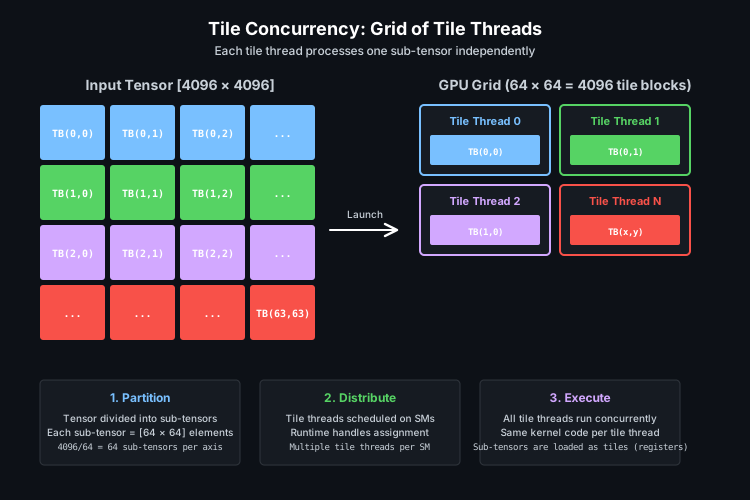
Within a kernel, each tile block can query its coordinates in the grid and the total grid dimensions:
#[cutile::entry()]
fn kernel<const S: [i32; 2]>(
    output: &mut Tensor<f32, S>,
    input: &Tensor<f32, {[-1, -1]}>
) {
    let pid: (i32, i32, i32) = get_tile_block_id();    // This block's (x, y, z)
    let grid: (i32, i32, i32) = get_num_tile_blocks();  // Grid dimensions

    // For element-wise ops, load_tile_like uses the output's
    // partition to determine which region this block processes:
    let tile = load_tile_like(input, output);
    output.store(tile);
}
Tile blocks that fit on available SMs run in parallel; the full set of tile blocks runs concurrently, with unspecified relative order. See Thinking in Tiles for the partitioning rules that drive the grid geometry.
Compile-Time vs Runtime Values#
cuTile Rust enforces compile-time constantness for values the compiler needs to reason about. Compile-time constants include tile dimensions (shape of tiles in registers), element dtypes, and reduction axes. Runtime values include tensor dimensions (size of input tensors), tensor data, and grid size (number of tile blocks to launch).
#[cutile::entry()]
fn kernel<const TILE_SIZE: [i32; 2]>(
    output: &mut Tensor<f32, TILE_SIZE>,  // Tile shape: compile-time constant
    input: &Tensor<f32, {[-1, -1]}>       // Tensor shape: runtime
) {
    let tile = load_tile_like(input, output);

    let max_vals = reduce_max(tile, 1i32);  // Reduction axis: compile-time constant

    output.store(tile);
}
Compile-time constants drive specialization: each unique combination of const generic values triggers its own compilation. Keeping the set of distinct specializations small matters for compile time and binary size.
Continue to Device Operations for the host-side execution story. For tuning tile sizes and architecture-specific hints, see Tuning for Performance.