

Tuning for Performance#
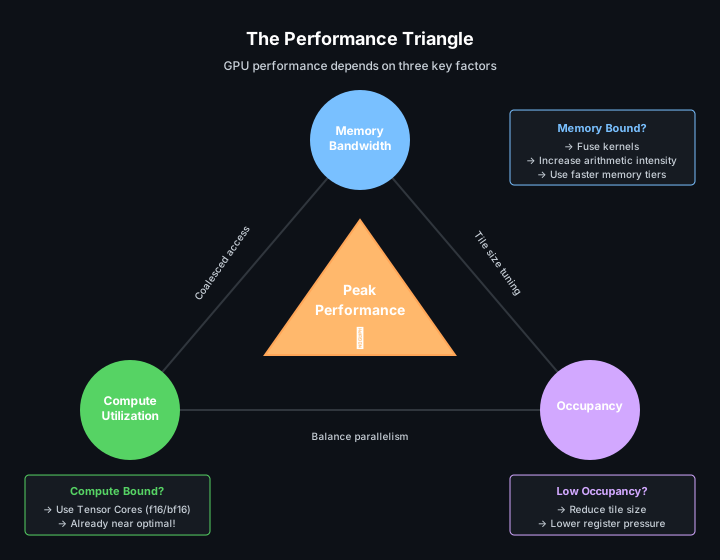
GPU performance optimization balances three concerns: memory bandwidth (moving data efficiently), compute utilization (keeping ALUs busy), and occupancy (maximizing parallel execution). Good kernels are well-balanced across all three; poor kernels are bottlenecked on one.
For algorithms where peak performance requires warp-level control or integration with hand-tuned CUDA C++ kernels, see Interoperability.
Compiler Hints and Specialization#
cuTile Rust provides optimization_hints at two levels: entry-level (kernel-wide) and per-op (on individual load/store operations).
Entry-level hints go on the entry annotation. They can also be overridden at runtime via CompileOptions for autotuning — different values trigger separate JIT compilations and are part of the kernel cache key:
#[cutile::entry(
    optimization_hints = (
        sm_120 = (                       // Blackwell-specific hints
            num_cta_in_cga = 2,
            occupancy = 2,
            max_divisibility = 16,
        ),
        sm_90 = (                        // Hopper-specific hints
            num_cta_in_cga = 1,
        ),
    )
)]
fn optimized_kernel<const S: [i32; 2]>(...) { ... }

// Runtime override for autotuning:
use cutile::tile_kernel::CompileOptions;

let result = my_kernel(input)
    .compile_options(CompileOptions::default().occupancy(4).num_cta_in_cga(2))
    .grid(grid)
    .await?;
Per-op hints (latency, disallow_tma) apply to individual load/store operations:
let tile: Tile<f32, S> =
    load_view_tko(&partition, idx, ordering::Weak, scope::TileBlock, Some(4), tma::Enabled);
unsafe {
    store_view_tko_mut(&mut partition, tile, idx, ordering::Weak, scope::TileBlock, None, tma::Disabled);
}
let (values, token) =
    load_ptr_tko(ptrs, ordering::Weak, None::<scope::TileBlock>, None, None, None, Latency::<4>);
Level |
Hint |
Description |
Default |
|---|---|---|---|
Entry |
|
Cap on auto-inferred alignment divisor |
16 |
Entry |
|
CTAs in Cooperative Group Array |
1 |
Entry |
|
Target occupancy level |
Auto |
Per-op |
|
Latency optimization hint ( |
Compiler decides / |
Per-op |
|
Disable Tensor Memory Accelerator for this op |
|
Tile size significantly impacts performance. Larger tiles mean fewer memory transactions but more registers per block, reducing occupancy. General guidelines:
GPU Architecture |
Recommended Tile Sizes |
|---|---|
Ampere (A100) |
|
Hopper (H100) |
|
Ada (RTX 4090) |
|
Tile Size |
Registers (approx) |
Max Occupancy |
|---|---|---|
|
~32 |
High |
|
~64-128 |
Medium-High |
|
~256+ |
Medium |
The preferred safe performance path is a mapped output partition. The output
partition produces bounded, disjoint indices, while input partitions use
with_bounds(...) to carry the matching logical grid:
fn gemm_persistent<
    T: ElementType,
    const BM: i32, const BN: i32, const BK: i32,
    const MAP_SHAPE: [i32; 2],
>(
    mut z: MappedPartitionMut<T, { [BM, BN] }, MAP_SHAPE>,
    x: &Tensor<T, { [-1, -1] }>,
    y: &Tensor<T, { [-1, -1] }>,
) {
    let m = num_tiles(&z, 0);
    let n = num_tiles(&z, 1);
    let k = Dim::new(x.shape()[1] / BK);

    let part_x = x.partition(const_shape![BM, BK]).with_bounds((m, k));
    let part_y = y.partition(const_shape![BK, BN]).with_bounds((k, n));

    for out_idx in z.iter_indices() {
        let (bid_m, bid_n) = out_idx.components();
        let acc = compute_tile(bid_m, bid_n, k, &part_x, &part_y);
        z.store(acc, out_idx);
    }
}
On the host side, .map(...) defines the output traversal and lets the launch
grid be inferred from the mapped partition:
let z = z.partition([BM, BN]).map([4, 1], num_tile_blocks);
let (z, _x, _y) = gemm_persistent(z, x, y)
    .generics(generics)
    .sync_on(&stream)?;
unchecked_accesses = true remains available when the programmer wants to opt
out of all runtime bounds checks explicitly:
#[cutile::entry(unchecked_accesses = true)]
unsafe fn fast_kernel<const S: [i32; 2]>(...) {
    // No bounds checking - programmer must ensure correctness
}
The older fully static GEMM pattern can also eliminate checks safely by making
all tensor dimensions const generics and passing the launch grid with
.const_grid(...). That path is mainly useful for legacy kernels or workloads
with a very small fixed set of problem sizes; every new full tensor shape
specializes the JIT compilation.
Memory Optimization#
Coalesced access — adjacent threads reading adjacent memory locations — is how the GPU memory system is designed to be used. cuTile Rust’s tile load operations automatically generate coalesced access patterns, so you get this for free from load_tile_like, Partition::load, and the standard loading APIs.
Keep data in registers. Load once from global memory, compute many times in registers:
Memory Level |
Latency |
Strategy |
|---|---|---|
Registers |
~0 cycles |
Keep data in tiles |
Shared Memory |
~20 cycles |
Reuse across iterations |
L2 Cache |
~200 cycles |
Temporal locality |
Global Memory |
~400 cycles |
Minimize accesses |
#[cutile::entry()]
fn fused_ops<const S: [i32; 2]>(
    output: &mut Tensor<f32, S>,
    input: &Tensor<f32, {[-1, -1]}>
) {
    // Single load from global memory
    let tile = load_tile_like(input, output);

    // Multiple operations in registers (free!)
    let normalized = tile - reduce_max(tile, 1i32);
    let exp_vals = exp(normalized);
    let softmax = true_div(exp_vals, reduce_sum(exp_vals, 1));

    // Single store to global memory
    output.store(softmax);
}
Kernel fusion is the register strategy scaled up — combining multiple logical operations into a single kernel. A pipeline of 3 kernels might read and write intermediate results to global memory 6 times; fusing into one kernel eliminates most of those round-trips:
// UNFUSED: 3 kernels, 6 loads + 3 stores total.

// FUSED: 1 kernel, 3 loads + 1 store (3× memory reduction).
#[cutile::entry()]
fn fused<const S: [i32; 2]>(
    w: &mut Tensor<f32, S>,
    a: &Tensor<f32, {[-1, -1]}>,
    b: &Tensor<f32, {[-1, -1]}>,
    c: &Tensor<f32, {[-1, -1]}>
) {
    let tile_a = load_tile_like(a, w);
    let tile_b = load_tile_like(b, w);
    let tile_c = load_tile_like(c, w);

    // All in registers — no intermediate memory traffic
    let y = tile_a + tile_b;
    let z = y * tile_c;
    let result = exp(z);

    w.store(result);
}
For the full memory hierarchy model and arithmetic intensity analysis, see Where Data Lives.
Compute Optimization#
Tensor Cores deliver massive throughput for matrix operations when shapes align. Express matrix multiply through mma with compatible [M, K], [K, N], and [M, N] tile shapes; the compiler lowers supported dtype/shape combinations to Tensor Core instructions:
#[cutile::entry()]
fn tensor_core_matmul<const M: i32, const N: i32, const K: i32>(
    c: &mut Tensor<f32, {[M, N]}>,  // f32 accumulator
    a: &Tensor<f16, {[-1, -1]}>,
    b: &Tensor<f16, {[-1, -1]}>
) {
    let part_a = a.partition(const_shape![M, K]);
    let part_b = b.partition(const_shape![K, N]);
    let pid: (i32, i32, i32) = get_tile_block_id();
    let tile_a = part_a.load([pid.0, 0i32]);
    let tile_b = part_b.load([0i32, pid.1]);

    let acc = constant(0.0f32, c.shape());
    let result = mma(tile_a, tile_b, acc);
    c.store(result);
}
Arithmetic intensity is FLOPs per byte transferred. Higher is better: high-intensity kernels are compute-bound rather than memory-bound.
Operation |
Arithmetic Intensity |
Bound |
|---|---|---|
Vector Add |
~0.1 |
Memory |
Matrix-Vector |
1-2 |
Memory |
Matrix-Matrix |
O(N) |
Compute |
Fused Softmax |
~10+ |
Compute |
See Where Data Lives: Arithmetic Intensity for the full treatment.
Instruction-level parallelism (ILP) lets the compiler overlap independent operations. Write independent branches explicitly so the compiler can schedule them in parallel:
// Independent operations — compiler can overlap them
let sum1 = reduce_sum(tile1, 1i32);
let sum2 = reduce_sum(tile2, 1i32);  // Can execute concurrently

// Dependent operations — serialize
let step1 = tile * 2.0;
let step2 = step1 + 1.0;  // Must wait for step1
Profiling and Pitfalls#
Focus on four metrics when profiling with Nsight Compute:
Metric |
Target |
|---|---|
Memory Throughput |
>80% of peak for memory-bound kernels |
Compute Throughput |
>70% for compute-bound kernels |
Occupancy |
>50% |
Register Spills |
0 |
Identify the bottleneck from the profile:
High memory throughput, low compute → memory-bound; increase arithmetic intensity, fuse kernels.
Low memory throughput, high compute → compute-bound; already near-optimal for this algorithm.
Low on both, high stall cycles → latency-bound; increase parallelism, overlap independent operations.
Common pitfalls:
Wrong tile size.
[8, 8]is usually too small (overhead dominates);[512, 512]is usually too large (register spills, low occupancy). Start with[64, 64]or[128, 128].Wrong dtype. Using
f32whenf16/bf16would suffice leaves 2× Tensor Core throughput on the table.Excessive synchronization. Let the compiler handle thread synchronization; avoid introducing extra sync points.
Algorithmic stride. Tile operations coalesce automatically, but strided access patterns in your algorithm logic defeat this.
Pre-ship checklist: tile size appropriate for workload and architecture; memory access coalesced; kernel fusion applied where possible; data types optimized (f16/bf16 for Tensor Cores); arithmetic intensity maximized; occupancy balanced against tile size; profiled with Nsight Compute.
Continue to Interoperability for the escape hatch when tile programming isn’t enough, or Debugging and Profiling for deeper troubleshooting.