Spatially Sparse Convolutions
Created: 2026-04-18 17:02:44 PST Edited: 2026-05-03 19:15:00 PST
WarpConvNet implements spatially sparse convolutions on integer-grid voxel coordinates. This page is the conceptual entry point: what "spatially sparse" means, the mathematical definition, and visualizations of the four convolution regimes WarpConvNet supports.
For the user-facing API (layer constructors, kernel sizes, group / depthwise variants, generative decoders), see Variants & API. For the GEMM-level implementation (AB/ABt/AtB ops, kernel-map structures, algorithm picking), see Internals.
Spatial vs. feature vs. weight sparsity
"Sparsity" in neural networks is overloaded. Three distinct flavors show up in 3D work and they have completely different implications:
| Kind | What is sparse | Typical source | How WarpConvNet handles it |
|---|---|---|---|
| Spatial sparsity | Most grid coordinates are empty; only occupied coordinates carry features. | Native to 3D point clouds, LiDAR, voxel grids, occupancy fields. | Primary target. All convolutions on Voxels operate only on occupied coordinates. |
| Feature sparsity | Individual feature-channel values are zero (e.g. post-ReLU). | Activation sparsity, gated MoE, quantization. | Orthogonal; not exploited by the conv kernels here. |
| Weight sparsity | Pruned kernel weights are structurally zero. | Pruning for model compression. | Orthogonal; compatible but not exploited. |
The distinction between spatial and weight sparsity (and the motivation to study them jointly) is the subject of [1]. This page is about spatial sparsity — only the first row of the table.
Mathematical definition
Domain
Fix a spatial dimension \(D \in \{2, 3\}\) (sometimes 4 with a temporal axis). The convolution operates on the integer grid \(\mathbb{Z}^D\). Coordinates are written as bold lowercase, \(\mathbf{u} = (u_1, \ldots, u_D) \in \mathbb{Z}^D\).
Coordinate sets
A spatially sparse tensor is a pair
\(\mathcal{C}\) is the coordinate set (the explicitly stored, occupied voxels) and \(\mathbf{x}_{\mathbf{u}}\) is the per-coordinate feature vector of width \(C\). Only \(|\mathcal{C}| \ll |\mathbb{Z}^D|\) coordinates are materialized; everywhere else the tensor is implicitly zero.
Kernel offsets
A convolution kernel of (odd) size \(K\) in each axis is identified with its offset set
For \(D=3\) and \(K=3\) this is the familiar \(3{\times}3{\times}3\) box of 27 offsets. WarpConvNet also supports arbitrary offset sets \(\mathcal{K} \subset \mathbb{Z}^D\) (no requirement to be a box).
Generalized sparse convolution
Given an input tensor on \(\mathcal{C}^{\text{in}}\), an output coordinate set \(\mathcal{C}^{\text{out}} \subset \mathbb{Z}^D\), an offset set \(\mathcal{K}\), and per-offset weight matrices \(\mathbf{W}_{\mathbf{i}} \in \mathbb{R}^{C_{\text{out}} \times C_{\text{in}}}\) for \(\mathbf{i} \in \mathcal{K}\), the generalized sparse convolution [2] is
where the active-offset set at output coordinate \(\mathbf{u}\) is
That is: for each output coordinate \(\mathbf{u}\), only the kernel offsets that land on an occupied input coordinate contribute to the sum.
Cost
The total work is proportional to the number of occupied (input, output, offset) triples:
Compare to dense convolution, where work is \(|\mathbb{Z}^D \cap \text{volume}| \cdot |\mathcal{K}| \cdot C_{\text{in}} \cdot C_{\text{out}}\) — independent of how many cells are actually occupied. Spatial sparsity replaces "volume" with "occupied neighbor pairs", which is the entire point.
The four regimes — visual
Three flags on SparseConv3d / spatially_sparse_conv — stride,
transposed, generative — together with whether the input is dense
or sparse, give rise to the regimes below. (Animations illustrate the
2D case for visual clarity; the 3D case is identical with one extra axis.)
Dense input → dense output
The classical case: \(\mathcal{C}^{\text{in}}\) and \(\mathcal{C}^{\text{out}}\) are both every cell in some bounding box, and \(\mathcal{N}(\mathbf{u}, \mathcal{K}, \mathcal{C}^{\text{in}}) = \mathcal{K}\) at every interior \(\mathbf{u}\). The animation below sweeps the kernel over a \(3{\times}3\) output, pulling a \(3{\times}3\) patch from the dense input each step.
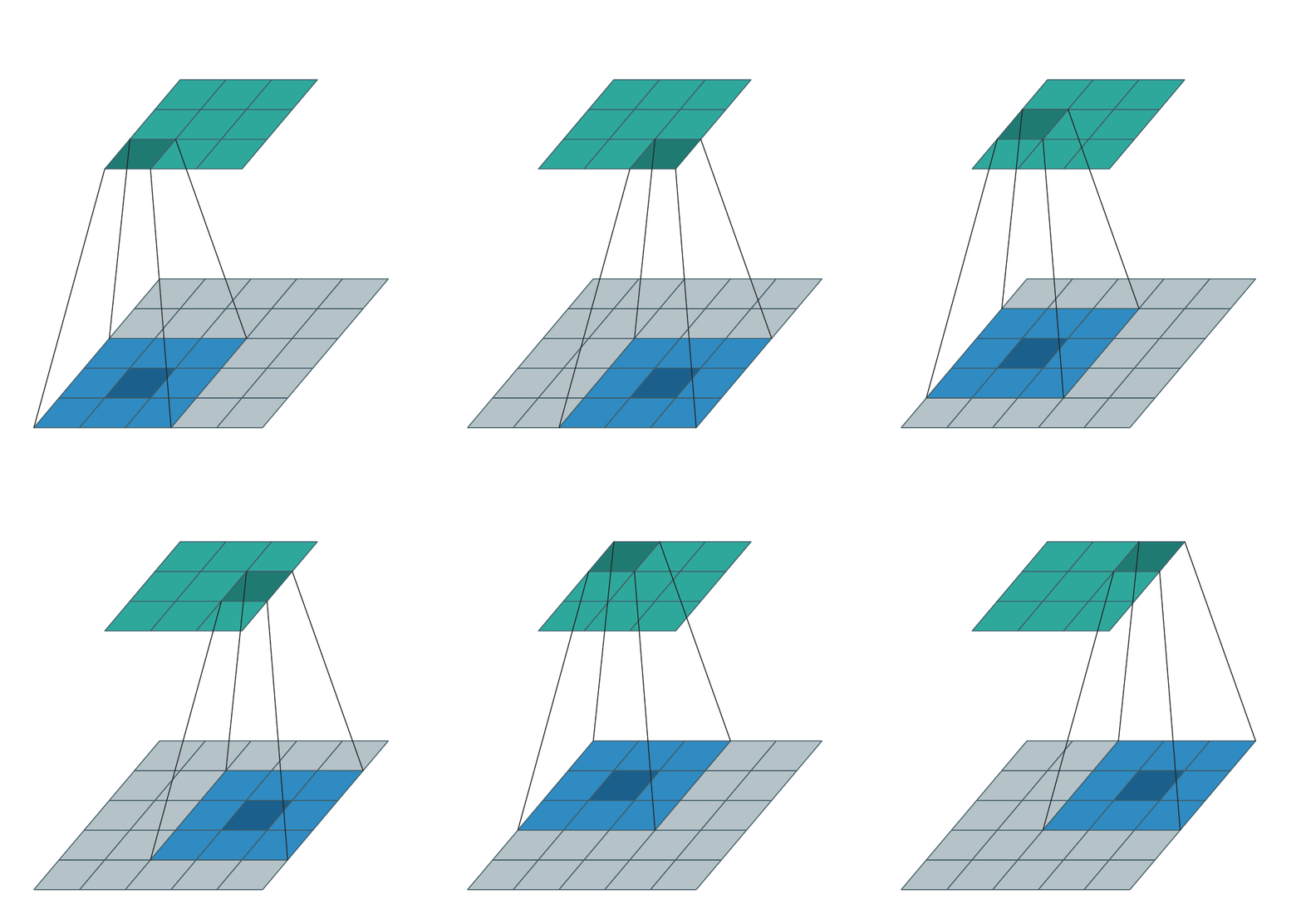
This is what torch.nn.Conv3d does. WarpConvNet handles it correctly but
gains nothing over a dense backend in this regime — there is no spatial
sparsity to exploit.
Sparse input → sparse output (stride > 1, downsampling)
\(\mathcal{C}^{\text{in}}\) is sparse (only a few occupied voxels). When
stride > 1, \(\mathcal{C}^{\text{out}}\) is the downsampled image of
\(\mathcal{C}^{\text{in}}\):
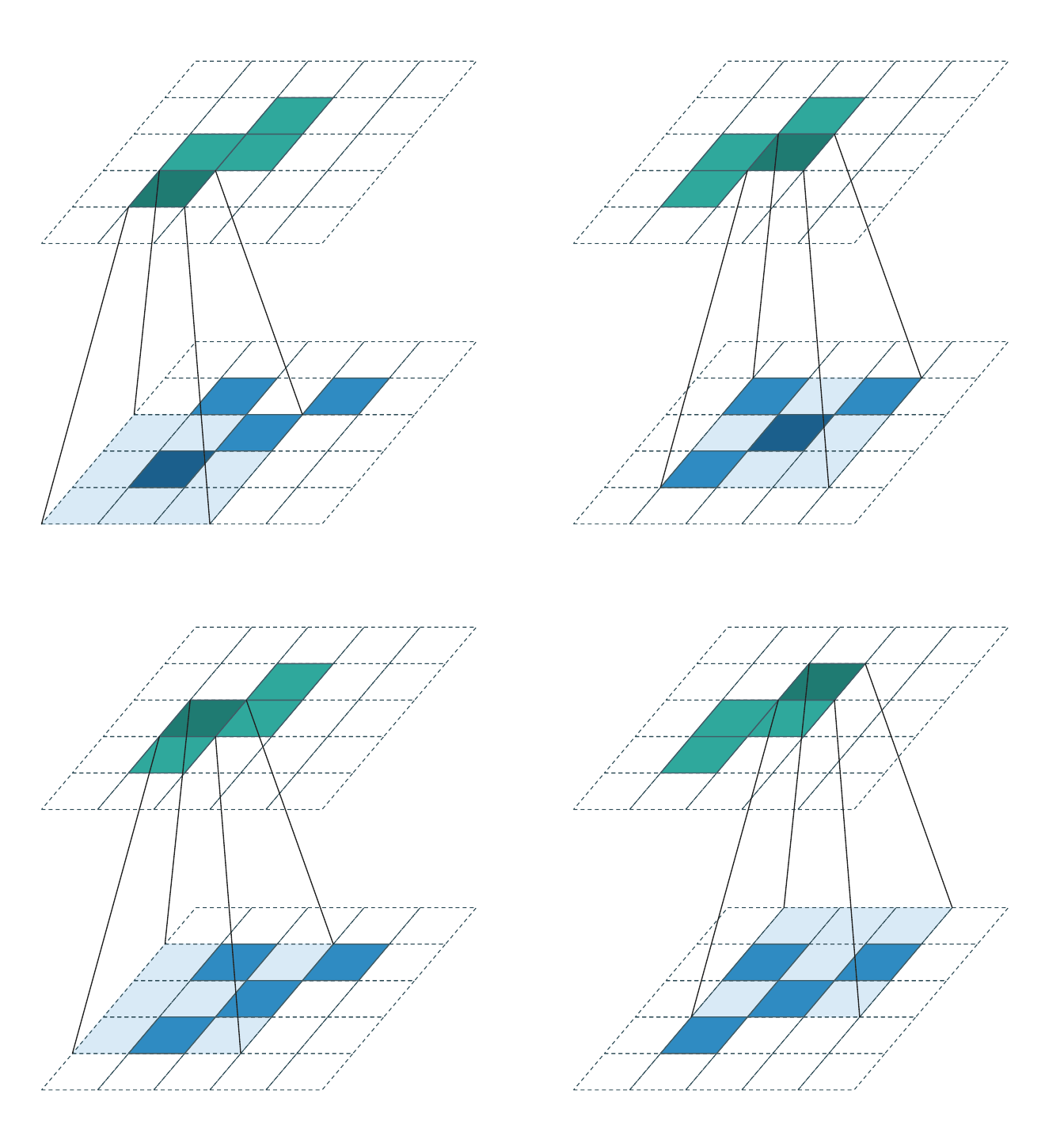
The frustum lines show the \(3{\times}3\) kernel reach for the focused output cell. Most cells inside the kernel reach are empty (dashed scaffold) — the active-offset set \(\mathcal{N}(\mathbf{u}, \mathcal{K}, \mathcal{C}^{\text{in}})\) is much smaller than \(|\mathcal{K}|\) in practice.
Stride = 1 (coordinate-preserving)
Special case of the above with stride 1 and generative=False:
Every input coordinate produces an output at the same coordinate; no new
sites are introduced and no sites are dropped. This is what
Graham & van der Maaten introduced as submanifold sparse convolution
[3]. WarpConvNet uses the stride-based name (SparseConv3d(stride=1)).
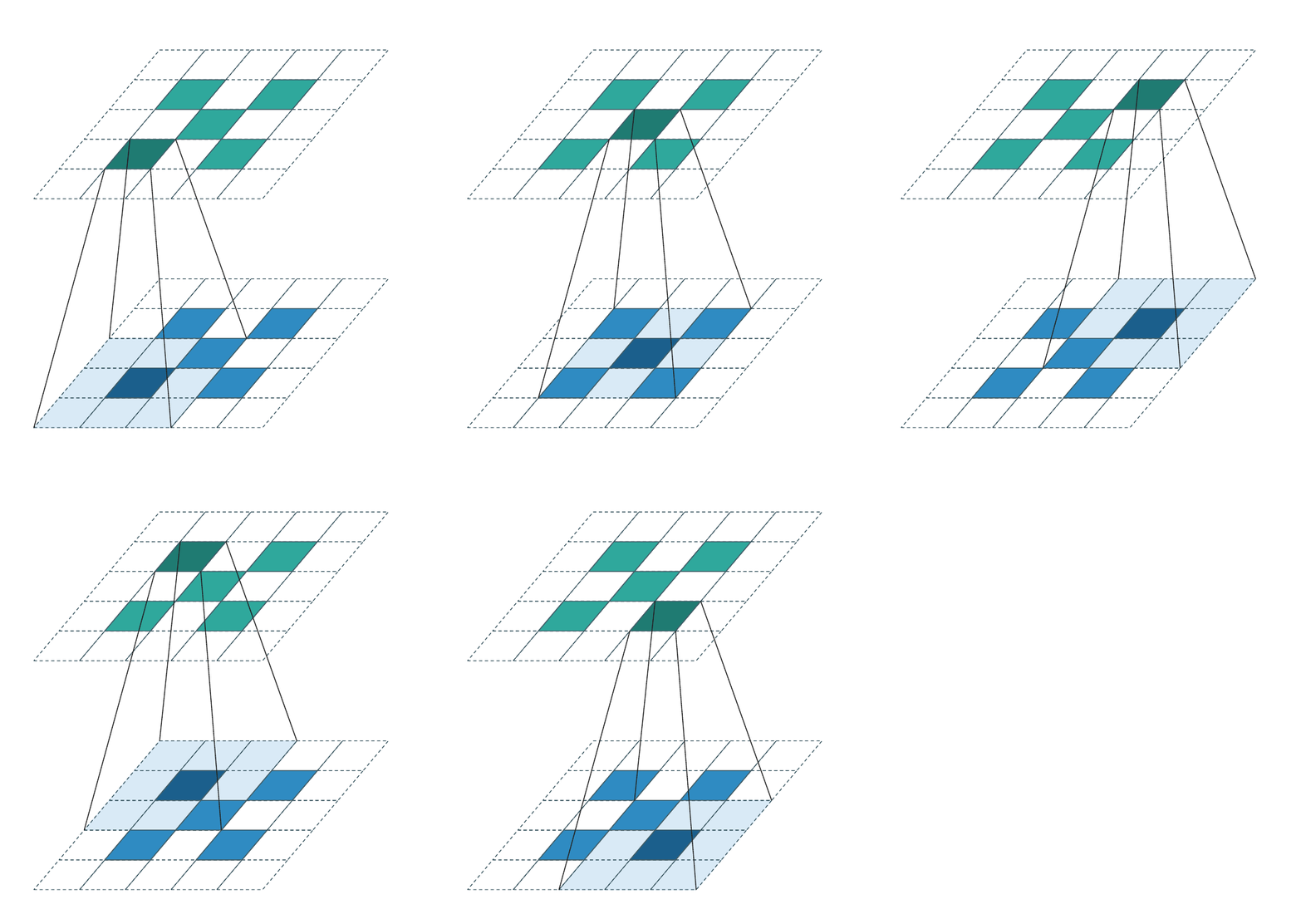
The output cell sits directly above its input twin. Kernel offsets that land on empty input cells contribute nothing. This is the workhorse inside sparse U-Net trunks: it preserves the occupied set across many layers, so spatial sparsity does not erode with depth.
Generative convolution
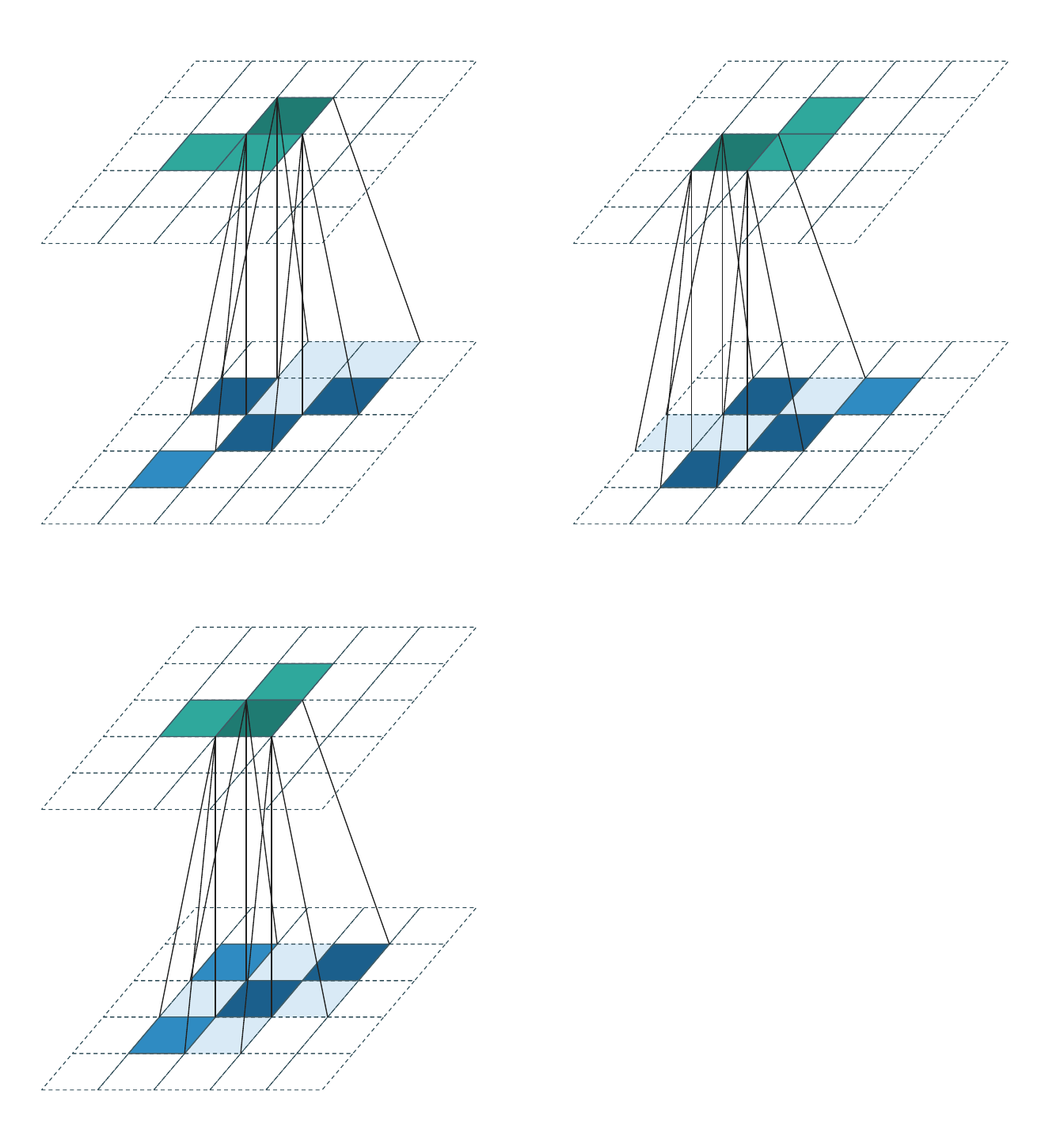
Generative convolution is the only regime that adds new coordinates. \(\mathcal{C}^{\text{out}}\) is constructed by expanding every input coordinate \(\mathbf{u} \in \mathcal{C}^{\text{in}}\) through the kernel:
The weight matrices are applied transposed relative to the forward direction (each output coordinate accumulates contributions from all input coordinates whose kernel reach covers it). Each animation frame highlights one input voxel and the output coordinates it generates (dark teal); output coordinates generated by other input voxels are shown in lighter teal.
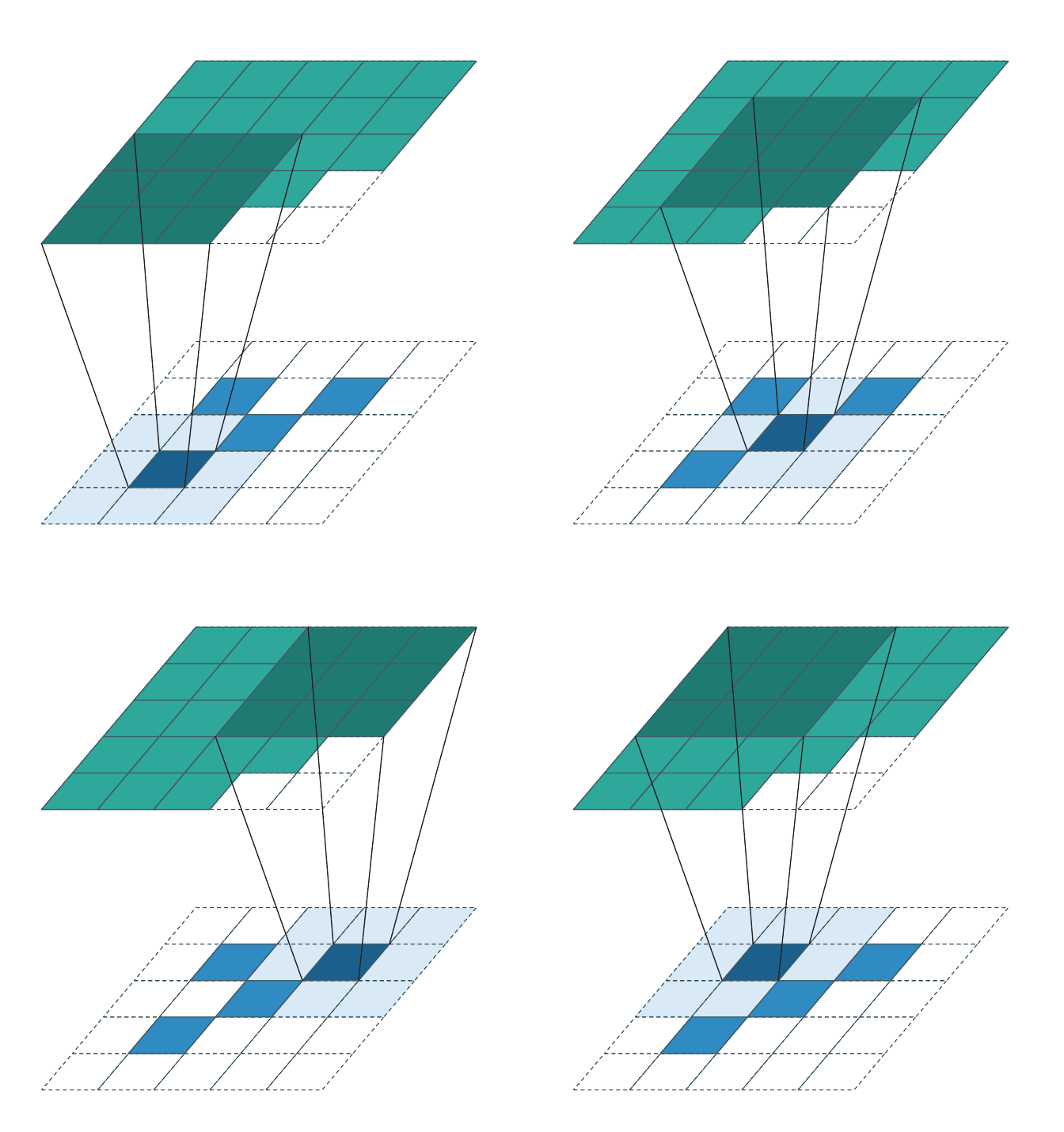
Successive generative layers progressively fill the occupied region and are the standard tool for sparse generative decoders and diffusion models.
Generalized convolution
\(\mathcal{K}\) need not be a box, and \(\mathcal{C}^{\text{out}}\) need not be derived from \(\mathcal{C}^{\text{in}}\) by stride or generative expansion. The most general form takes both as user-specified sets:
WarpConvNet uses this internally for transposed convolutions and for cross-attention-style custom kernel maps.
How \(\mathcal{C}^{\text{out}}\) is chosen
Summary table — full details and code examples in Variants & API.
| Regime | Flags | \(\mathcal{C}^{\text{out}}\) | Animation |
|---|---|---|---|
| stride=1 | stride=1 |
\(\mathcal{C}^{\text{in}}\) | stride1 |
| Downsampling | stride>1 |
Downsampled coordinates (one per stride cell) | sparse |
| Generative (stride=1) | generative=True, stride=1 |
\(\mathcal{C}^{\text{in}}\) expanded by the kernel support | generative |
| Generative (stride>1) | generative=True, stride>1 |
Stride first, then expand | (generalized form) |
| Transposed | transposed=True, stride>1 |
Upsampled coordinates by factor stride |
(generalized form) |
See also
- Variants & API —
SparseConv3d, group / depthwise variants, generative decoders, usage examples. - Internals — the three math kernels per layer (AB / ABt / AtB), algorithm taxonomy, source files.
- Auto-Tuning — per-shape algorithm selection and caching.
- Bilateral & Permutohedral Filters — sparse convolution lifted to high-dimensional lattices.
References
- Lee, J., Choy, C., Park, J. Putting 3D Spatially Sparse Networks on a Diet. arXiv:2112.01316, 2021. [arxiv]
- Choy, C., Gwak, J., Savarese, S. 4D Spatio-Temporal ConvNets: Minkowski Convolutional Neural Networks. CVPR 2019. arXiv:1904.08755. [arxiv]
- Graham, B., van der Maaten, L. Submanifold Sparse Convolutional Networks. arXiv:1706.01307, 2017. [arxiv] See also Graham, Engelcke, van der Maaten. 3D Semantic Segmentation with Submanifold Sparse Convolutional Networks. CVPR 2018. arXiv:1711.10275. [arxiv]