

Data Model & Types#
cuTile Rust leverages Rust’s type system to catch errors at compile time. Shape mismatches, type errors, and many common GPU programming bugs are caught before your code even runs.
Tensors vs Tiles#
cuTile Rust has two fundamental data abstractions that represent data at different levels of the memory hierarchy:
Property |
Tensor |
Tile |
|---|---|---|
Location |
Global Memory (HBM) |
GPU registers |
Mutability |
Mutable ( |
Immutable |
Shape |
Mixed static / dynamic |
Compile-time (static) |
Operations |
Load, Store |
Arithmetic, Reduction, etc. |
Lifetime |
Persists across kernels |
Exists only during kernel |
Addressable |
Yes (pointers) |
No (compiler-managed) |
// Tensors: live in global memory, passed as kernel arguments
fn kernel(
    output: &mut Tensor<f32, S>,      // Mutable tensor (can store to)
    input: &Tensor<f32, {[-1, -1]}>   // Immutable tensor (read-only)
) {
    // Tiles: live in registers, created by loading
    let tile = load_tile_like_2d(input, output);  // Load creates a tile
    let result = tile * 2.0;                      // Operations create new tiles
    output.store(result);                         // Store tile back to tensor
}
Element Types#
cuTile Rust supports various numeric types for GPU computation:
Floating Point Types#
Type |
Size |
Description |
Use Case |
|---|---|---|---|
|
16-bit |
Half precision |
Training, inference (2× Tensor Core throughput) |
|
32-bit |
Single precision |
General purpose, debugging |
|
64-bit |
Double precision |
Scientific computing |
|
19-bit |
TensorFloat-32 |
Tensor Core operations |
Integer Types#
Type |
Size |
Description |
|---|---|---|
|
8-bit |
Signed/unsigned byte |
|
32-bit |
Signed/unsigned int |
|
64-bit |
Signed/unsigned long |
Boolean Type#
Type |
Description |
|---|---|
|
Boolean (true/false), maps to |
Choosing Element Types#
Type |
Performance |
Precision |
Recommendation |
|---|---|---|---|
|
Baseline |
High |
Development, debugging |
|
2× on Tensor Cores |
Medium |
Inference |
|
2× on Tensor Cores |
Medium (better range) |
Training |
|
Native integer ops |
Exact |
Indexing, control flow |
Shapes#
Shapes define the dimensions of tensors and tiles.
Static Shapes (Compile-Time)#
When you know the shape at compile time, use const generics:
fn kernel<const BM: i32, const BN: i32>(
    output: &mut Tensor<f32, { [BM, BN] }>,  // Static shape
) {
    // BM and BN are known at compile time
    // Compiler can optimize layout and access patterns
}
Benefits:
Compiler can optimize layout and access patterns
Shape errors caught at compile time
Zero runtime overhead for shape checks
Drawbacks:
Kernels are re-compiled whenever their type or const generics change.
Too many consts which change across kernel launches will trigger excessive re-compilation, which may not be desirable/optimal for all applications.
Dynamic Shapes (Runtime)#
When the shape is only known at runtime:
fn kernel(
    input: &Tensor<f32, { [-1, -1] }>,  // Dynamic shape
) {
    // -1 means "determined at runtime"
    let shape = input.shape();  // Query actual dimensions
}
Dynamic shape dimensions which vary across kernel launches do not trigger re-compilation.
Common Tile Sizes#
For optimal performance, tile dimensions are typically powers of two:
Shape |
Total Elements |
Use Case |
|---|---|---|
|
4,096 |
General matrix ops |
|
16,384 |
Large matrix ops |
|
16,384 |
Tall tiles |
|
16,384 |
Wide tiles |
|
1,024 |
1D vectors |
The Common Pattern: Static Output, Dynamic Input#
#[cutile::entry()]
fn add<const S: [i32; 2]>(
    z: &mut Tensor<f32, S>,           // Static: tile knows its size
    x: &Tensor<f32, {[-1, -1]}>,      // Dynamic: full tensor
    y: &Tensor<f32, {[-1, -1]}>,      // Dynamic: full tensor
) {
    let tile_x = load_tile_like_2d(x, z);  // Load matching z's shape
    let tile_y = load_tile_like_2d(y, z);
    z.store(tile_x + tile_y);
}
Shape Broadcasting#
When operating on tiles of different shapes, cuTile Rust uses broadcasting rules similar to NumPy:
Broadcasting Rules#
Align dimensions from the right
Dimensions are compatible if they’re equal or one is 1
The result shape is the maximum along each dimension
// Example: [64, 64] + [1, 64] -> [64, 64]
let tile_a: Tile<f32, [64, 64]> = ...;
let tile_b: Tile<f32, [1, 64]> = ...;
let result = tile_a + tile_b.broadcast(const_shape![64, 64]);  // Result is [64, 64], B broadcast along dim 0
Core Types#
The Tensor and Partition types exist on both the host side (CPU) and the device side (GPU kernel), but they are different Rust types with similar semantics. Host-side types are parameterized by element type only; device-side types carry shape information in the type system for compile-time optimization.
Host-Side Types#
On the host, you allocate tensors, partition them, and pass them to kernel launchers:
// Host-side Tensor<T> — parameterized by element type only
let tensor: Tensor<f32> = zeros([1024, 1024]).sync_on(&stream)?;

// Host-side Partition<Tensor<T>> — wraps a tensor with a partition_shape
let partitioned: Partition<Tensor<f32>> = tensor.partition([16, 16]);
// 64×64 = 4096 sub-tensors, each 16×16

// Shared reference for read-only inputs
let shared: Arc<Tensor<f32>> = ones([1024, 1024]).arc().sync_on(&stream)?;
The generated launcher accepts Partition<Tensor<T>> for every &mut Tensor parameter and Arc<Tensor<T>> for every &Tensor parameter.
Device-Side Types#
Inside a kernel, tensors and tiles carry their shape as a type parameter. This enables compile-time shape checking and optimization:
// Device-side Tensor<E, S> — element type + shape
fn kernel(
    output: &mut Tensor<f32, { [BM, BN] }>,  // Static shape from partition
    input: &Tensor<f32, { [-1, -1] }>,       // Dynamic shape
) {
    // Device-side Partition<E, S> — view of a tensor as tiles
    let part = input.partition(const_shape![BM, BK]);
    let tile = part.load([pid.0, i]);

    // Tile<E, S> — immutable data fragment in registers
    let tile_a: Tile<f32, { [BM, BN] }> = load_tile_like_2d(input, output);
    let result = tile_a * 2.0;       // Operations create new tiles
    output.store(result);
}
Type |
Side |
Parameterized By |
Description |
|---|---|---|---|
|
Host |
Element type |
Tensor in global memory; allocated and managed on the CPU |
|
Host |
Element type |
Host-side wrapper recording a tensor and its partition shape |
|
Host |
Element type |
Shared reference for read-only kernel inputs |
|
Device |
Element type + shape |
Kernel parameter; |
|
Device |
Element type + shape |
Read-only view of a |
|
Device |
Element type + shape (always static) |
Immutable data fragment in GPU registers |
Type Safety#
Compile-Time Shape Checking#
The compiler catches shape mismatches:
// ❌ Won't compile: shapes don't match
let a: Tile<f32, {[4, 4]}> = ...;
let b: Tile<f32, {[8, 8]}> = ...;
let c = a + b;  // Error: cannot add [4,4] and [8,8]

// ✅ Correct: same shapes
let a: Tile<f32, {[4, 4]}> = ...;
let b: Tile<f32, {[4, 4]}> = ...;
let c = a + b;  // OK: both [4,4]
Element Type Checking#
// ❌ Won't compile: type mismatch without conversion
let x: Tile<f32, {[4, 4]}> = ...;
let y: Tile<i32, {[4, 4]}> = ...;
let z = x + y;  // Error: cannot add f32 and i32

// ✅ Correct: explicit conversion
let y_float: Tile<f32, {[4, 4]}> = convert_tile(y);
let z = x + y_float;  // OK
Matrix Multiplication Shape Rules#
For C = A @ B:
A shape:
[M, K]B shape:
[K, N]C shape:
[M, N]
The inner dimension K must match:
// ❌ Won't compile: inner dimensions don't match
let a: Tile<f32, {[16, 8]}>;   // [M=16, K=8]
let b: Tile<f32, {[16, 32]}>;  // [K=16, N=32]  K mismatch!
let c = mma(a, b, zeros);      // Error!

// ✅ Correct: K dimensions match
let a: Tile<f32, {[16, 8]}>;   // [M=16, K=8]
let b: Tile<f32, {[8, 32]}>;   // [K=8, N=32]   K matches!
let c = mma(a, b, zeros);      // OK: result is [16, 32]
Type Conversions#
Explicit Casting#
Convert between types explicitly:
let float_tile: Tile<f32, S> = ...;

// Float to integer
let int_tile: Tile<i32, S> = convert_tile(float_tile);

// Integer extension
let i8_tile: Tile<i8, S> = ...;
let i32_tile: Tile<i32, S> = convert_tile(i8_tile);
Generic Kernels#
Use generics to specify flexible, reusable kernels:
#[cutile::entry()]
fn flexible_gemm<
    E: ElementType,              // Any element type
    const BM: i32,               // Tile rows
    const BN: i32,               // Tile cols
    const BK: i32,               // Inner tile dim
    const K: i32,                // Full inner dim
>(
    z: &mut Tensor<E, {[BM, BN]}>,
    x: &Tensor<E, {[-1, K]}>,
    y: &Tensor<E, {[K, -1]}>,
) {
    // Works for any element type and tile sizes!
}
Launch with specific types:
let generics = vec![
    "f32".to_string(),  // E
    "16".to_string(),   // BM
    "16".to_string(),   // BN
    "8".to_string(),    // BK
    "128".to_string(),  // K
];
gemm(z, x, y).generics(generics).sync_on(&stream);
The ElementType Trait#
Custom element types must implement ElementType:
pub trait ElementType: Copy + Clone {}

// Built-in implementations:
impl ElementType for f32 { ... }
impl ElementType for f16 { ... }
impl ElementType for i32 { ... }
// etc.
Memory Layout#
Tensor Memory Layout#
Tensors in global memory use row-major (C-style) layout:
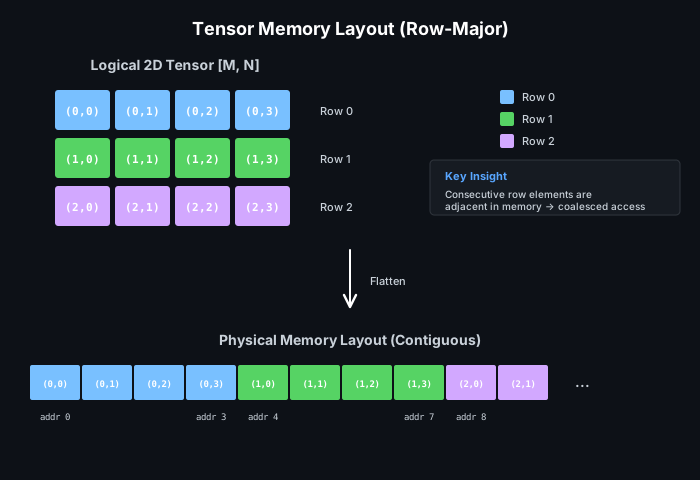
Key insight: Consecutive elements in a row are adjacent in memory, enabling coalesced memory access when threads read along rows.
Tile Register Layout#
Tiles exist in registers without a specific addressable layout. The compiler optimizes register usage automatically.
Shape Utilities#
const_shape! Macro#
Create compile-time shapes:
use cutile::core::const_shape;

let shape = const_shape![64, 64];       // [64, 64]
let shape_3d = const_shape![8, 16, 32]; // [8, 16, 32]
Shape Operations#
// Get shape at runtime
let dims = tensor.shape();  // Returns shape info

// Reshape (total elements must match)
let reshaped = tile.reshape(const_shape![8, 8]);

// Broadcast (expand dimensions)
let scalar: Tile<f32, {[]}> = constant(2.0f32, const_shape![]);
let expanded = scalar.broadcast(const_shape![64, 64]);
Summary#
Concept |
Purpose |
|---|---|
Static shapes |
Compile-time known, fully optimized |
Dynamic shapes |
Runtime determined |
Tensor<T> (host) |
Tensor in global memory, allocated and managed on the CPU |
Tensor<E, S> (device) |
Kernel parameter with element type and shape |
Partition<Tensor<T>> (host) |
Wrapper recording a tensor and its partition shape |
Partition<E, S> (device) |
Read-only view of a tensor divided into tiles inside a kernel |
Tile<E, S> (device only) |
Immutable data fragment in GPU registers |
Const generics |
Flexible, type-safe kernels |
Broadcasting |
Automatic shape expansion |
Key benefits:
Catch shape mismatches at compile time
Zero runtime overhead for static shapes
Generic kernels work with any valid configuration
Next Steps#
See Operations for available tile operations
Learn about Memory Hierarchy for performance
Explore the Syntax Reference for complete API